
CBN
A mildly psychoactive phytocannabinoid that is formed mainly as an oxidative product of THC and is well-known for it’s sedating properties.
Last updated: 21 September 2026
CBN at a glance
Naturally occurring
Yes
Psychoactive
Mildly intoxicating
Cannabinoid type
Phytocannabinoid
Discovery year
1896
Also known as
Cannabinol, CAS 521‑35‑7
Molecular formula
C21H26O2
CB1 receptor interaction
Agonist
CB2 receptor interaction
Agonist
What is CBN?
CBN is a mildly intoxicating phytocannabinoid found naturally in Cannabis sativa, where it forms mainly through the oxidation and ageing of Delta-9-THC rather than being produced directly by the plant. It is generally considered around 0.1× as psychoactively potent as Delta-9-THC. CBN is especially known for its relaxing and sedating character and has become popular in sleep-focused cannabinoid products.
CBN has a five-carbon (pentyl) side chain and is structurally closely related to Delta-9-THC. During oxidation, the central THC ring becomes fully aromatic, creating the characteristic CBN structure. This structural change makes CBN chemically and biologically distinct from the THC from which it originates.
Commercial CBN is generally obtained through purification from cannabinoid extracts or produced through controlled conversion of other cannabinoids and is commonly supplied as a high-purity isolate. It is typically white with a fine crystalline powder consistency. CBN is relatively chemically stable and represents one of the major final oxidation products formed as Delta-9-THC ages.
CBN was the first phytocannabinoid isolated from cannabis, with its isolation dating to the late 19th century. Its structure was clarified during the 1930s and definitively established through synthesis in 1940. Despite this long history, CBN received relatively little attention for decades, but scientific and commercial interest has increased substantially because of its association with relaxation and sleep.
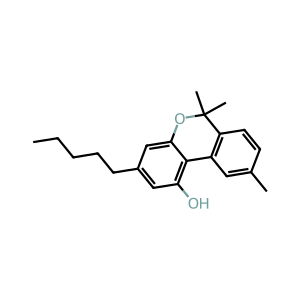
How CBN works in the human body
CBN shows weak CB1 activity and limited THC-like intoxication, with a theoretical psychoactive potency of around 0.1x Delta-9-THC. It also interacts with CB2, voltage-gated sodium channels and TRP ion channels, which may contribute to effects involving pain, sensory responses and inflammation. CBN is also converted into 11-OH-CBN, an active metabolite with substantially stronger CB1 activity.
CB1 receptor
The main cannabinoid receptor in the brain, responsible for THC’s intoxicating effects, binds CBN with a Ki of approximately 211 nM, compared with about 40.7 nM for Delta-9-THC, meaning Delta-9-THC shows roughly 5.2x stronger CB1 binding affinity.
CBN acts as a weak partial CB1 agonist. A human-receptor research found an EC50 of approximately 4 µM for CBN versus 0.4 µM for Delta-9-THC, making CBN roughly 10x less potent in that signalling pathway. Its maximum response was also substantially lower, around 29% versus 72% for THC. Human research further found that 50 mg oral CBN alone did not produce the characteristic intoxication caused by 25 mg THC.
Considering its approximately 5x weaker CB1 binding, 10x lower functional potency, much lower maximum receptor response and limited THC-like effects in humans, CBN is theoretically estimated at around 0.1x the psychoactive potency of Delta-9-THC. This is an evidence-based estimate rather than a directly measured human potency ratio.
CB2 receptor
The main cannabinoid receptor in the immune system, involved in regulating immune cell activity and inflammatory responses. CBN binds CB2 with a Ki of approximately 126 nM, compared with around 36.4 nM for Delta-9-THC, meaning Delta-9-THC shows approximately 3.5x stronger CB2 binding affinity.
CBN can act as a CB2 agonist, with an early functional assay reporting an EC50 of 261 nM. However, newer human-receptor experiments found negligible CB2 activation below 10 µM, showing that its functional activity varies substantially between experiments. CB2-mediated immune or inflammatory effects therefore remain plausible, but their importance in humans has not been established.
Voltage-gated sodium channels
Voltage-gated sodium channels help sensory nerves generate electrical signals, including those involved in transmitting pain. CBN inhibits human NaV1.7 and NaV1.8, with NaV1.7 IC50 values of approximately 10.7 to 29.9 µM.
Inhibiting these channels can make pain-sensing nerves less likely to become activated and repeatedly transmit pain signals. This could potentially contribute to reduced pain sensitivity and less persistent pain signalling, although these effects have not been confirmed clinically in humans.
TRP ion channels
TRP channels help sensory nerves detect temperature, irritation and pain-related signals. CBN strongly activates TRPA1 with an EC50 of approximately 0.18 µM and blocks the cold-sensing TRPM8 channel with an IC50 of approximately 0.21 µM. CBN also activates TRPV2, TRPV3 and TRPV4, although generally only at higher concentrations.
Together, these interactions likely influence pain, temperature sensitivity and inflammatory responses, although their exact contribution to CBN’s effects in humans remains uncertain.
Metabolism
Human liver enzymes convert CBN into several metabolites, including 11-OH-CBN.
Animal and human-receptor research found that 11-OH-CBN reaches the brain and acts as a CB1 partial agonist, with potency and maximum activity approaching Delta-9-THC in one receptor assay. This suggests that 11-OH-CBN could contribute meaningfully to CBN’s effects after metabolism, although its independent psychoactive potency has not been established in humans.
✓
Human safety status
No short term harm found, long term data not yet established
Controlled human studies have examined single doses up to 300 mg and repeated 20 mg nightly for seven days. Reported adverse effects were generally mild, with no serious safety signal established, although 300 mg produced modest subjective intoxication in some participants. Repeated and long-term exposure remain insufficiently studied, so a complete human safety profile cannot yet be established.
CBN interactions with other compounds
CBN can interact with other cannabinoids, common substances and medicines by changing their metabolism, blood exposure or biological effects. These interactions may increase, decrease or modify the effects of either compound, and can sometimes change how long those effects remain active in the body. Their strength and relevance can vary substantially depending on the specific combination, dose and route of administration.
Important disclaimer
This information is provided for educational and technical reference only. Interaction data can change as new research becomes available and may be incomplete or outdated. The real relevance of any interaction depends strongly on dose, route of administration, timing, formulation and individual metabolism. Readers should do their own research and consult a qualified healthcare professional before making decisions involving medicines, alcohol, nicotine, cannabinoids or other compounds. Elementra's products and information are intended for research, production and technical use only and are not intended for human consumption.
Medicines
Capsaicin
Cell study
Capsaicin-induced nerve signalling decreases
CBN directly reduced the response of sensory neurons to capsaicin in laboratory testing. Capsaicin-induced calcium influx was completely blocked in about 71% of responsive neurons, while responses were reduced in many others. This suggests that CBN can weaken capsaicin-related pain signalling, but the interaction has not yet been confirmed in humans.
Warfarin
Enzyme study
Warfarin blood exposure may increase
CBN directly inhibited CYP2C9-mediated breakdown of S-warfarin in human liver enzyme testing. By slowing warfarin metabolism, CBN could increase its blood exposure and strengthen its anticoagulant effect, potentially increasing bleeding risk. This interaction has not yet been measured or confirmed in humans.
Diclofenac
Enzyme study
Diclofenac blood exposure may increase
CBN directly inhibited CYP2C9-mediated metabolism of diclofenac in human liver enzyme testing. By slowing diclofenac breakdown, CBN could increase its blood exposure and potentially strengthen or prolong concentration-related effects. The resulting increase in blood exposure has not yet been confirmed in humans.
Bupropion
Enzyme study
Bupropion blood exposure may increase
CBN strongly inhibits CYP2B6-mediated metabolism of bupropion in laboratory testing. By slowing the conversion of bupropion, CBN could increase the amount of unchanged bupropion remaining in the bloodstream and potentially prolong or strengthen its effects. This pharmacokinetic interaction has not yet been confirmed in humans.
Chlorzoxazone
Enzyme study
Chlorzoxazone blood exposure may increase
CBN strongly inhibits CYP2E1-mediated metabolism of chlorzoxazone in laboratory testing. By slowing chlorzoxazone breakdown, CBN could increase its blood exposure and potentially prolong or strengthen its effects. The resulting interaction has not yet been measured or confirmed in humans.
Related terms
Educational information only
This content does not constitute advice
All information in the Cannabinoid Knowledge Hub is provided solely for educational and scientific purposes. It does not constitute medical advice, usage advice, dosage guidance or instructions for mixing, combining or consuming substances.
Discussions of effects, interactions and risks are descriptive only and should not be interpreted as a recommendation or encouragement to use or combine any substance. Visitors are responsible for complying with all applicable laws and regulations in their country or jurisdiction. Nothing in the Knowledge Hub may be used to support illegal activity.
Read the full disclaimer