
CBNP
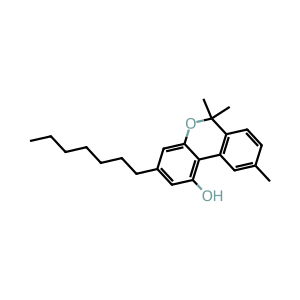
A rare phytocannabinoid analog of CBN featuring a longer seven-carbon (heptyl) side chain instead of CBN’s five-carbon (pentyl) chain.
Last updated: 21 September 2026
CBNP at a glance
Naturally occurring
Not directly
Psychoactive
Not enough data
Cannabinoid type
Phytocannabinoid
Discovery year
Uknown
Also known as
Cannabiphorol, CBN-C7, CBN-Heptyl, CAS 55824-14-1
Molecular formula
C23H30O2
CB1 receptor interaction
Potential agonist (not enough data)
CB2 receptor interaction
Potential agonist (not enough data)
What is CBNP?
CBNP is a rare phytocannabinoid and the seven-carbon homologue of CBN. Its acidic precursor CBNPA has been detected in Cannabis sativa, supporting CBNP as part of the heptyl cannabinoid family, although neutral CBNP itself has not yet been directly isolated from the plant. CBNP is expected to be intoxicating, likely more strongly than CBN, but almost no direct pharmacological or human data are currently available.
CBNP has the same basic structure as CBN but contains a seven-carbon (heptyl) side chain instead of the five-carbon (pentyl) side chain of CBN. This longer side chain is associated with increased cannabinoid activity to cannabinoid receptors, making CBNP chemically distinct from conventional CBN.
Commercial CBNP is produced synthetically or semi-synthetically and is generally supplied as a viscous distillate or purified material. Synthesised CBNP has been described as a pale-yellow oil. Its fully aromatised CBN-type structure is expected to provide relatively high chemical stability compared with other THC-type cannabinoids.
Scientific knowledge of CBNP remains extremely limited. Interest increased following the discovery of seven-carbon cannabinoids such as THCP and CBDP in 2019, while CBNPA was identified in cannabis in 2021. CBNP itself has received almost no dedicated research, leaving major gaps regarding its potency, human effects, safety and pharmacokinetics.
How CBNP works in the human body
CBNP’s human pharmacology remains largely unknown. Computational research predicts interactions with CB1, CB2 and PAK1, but no experimental CBNP receptor affinity, functional activity or human effects have been established. Metabolism has also not been directly studied.
CB1
The main cannabinoid receptor in the brain, responsible for THC’s intoxicating effects, may interact strongly with CBNP, but this has only been predicted computationally, were CBNP docked in a CB1 receptor. However, no CBNP Ki, EC50 or confirmed agonist activity is known, so CB1-mediated intoxication cannot currently be verified.
The structural close analogous cannabinoid THCP increased CB1 affinity roughly 33-fold compared with it’s five-carbon counterpart Delta-9-THC. Since CBN itself is already a weak CB1 partial agonist, applying the same heptyl-chain effect suggests CBNP could bind CB1 considerably more tightly than CBN, which potentially produces more pronounced CB1-mediated effects than CBN, like sedation. This remains an extrapolation from a structurally related cannabinoid pair and has not been confirmed by any direct study on CBNP.
CB2
The main cannabinoid receptor in the immune system, involved in regulating immune cell activity and inflammatory responses. No binding or functional data exist for CBNP at CB2 either. In the THC/THCP comparison, the heptyl chain increased CB2 affinity about 5 to 10x compared to Delta-9-THC. Because CBN already shows preferential CB2 affinity linked to anti-inflammatory signalling, the same chain-length pattern suggests CBNP could retain or enhance CB2 engagement relative to CBN, but this inference has also not been tested directly and remains unconfirmed.
PAK1
PAK1 is an enzyme that helps cells control movement, shape, growth and communication with other cellular systems. PAK1 also helps regulate the cell’s internal structural framework, known as the cytoskeleton, which supports the cell and allows it to change shape or move.
Computational research predicted that CBNP may bind strongly to PAK1. However, these computer models only predict whether CBNP could physically interact with PAK1. They do not prove that CBNP actually inhibits or activates the enzyme. No laboratory or human research has yet confirmed a PAK1 effect, so any biological consequences remain speculative.
Metabolism
CBNP metabolism has not been experimentally characterised. Based on CBN metabolism, hydroxylated CBNP metabolites, potentially including 11-OH-CBNP, followed by conjugated metabolites, would be plausible, but none have been confirmed and their activity is unknown.
✓
Human safety status
No direct data, considered likely safe based on similar cannabinoids
No human acute, repeated or long-term safety studies exist specifically for CBNP. Human evidence for the related CBN includes controlled repeated administration without evidence establishing serious toxicity, but this cannot determine CBNP safety because its pharmacological potency is unknown. A reliable human safety profile for CBNP therefore cannot currently be established.
CBNP interactions with other compounds
CBNP can interact with other cannabinoids, common substances and medicines by changing their metabolism, blood exposure or biological effects. These interactions may increase, decrease or modify the effects of either compound, and can sometimes change how long those effects remain active in the body. Their strength and relevance can vary substantially depending on the specific combination, dose and route of administration.
Important disclaimer
This information is provided for educational and technical reference only. Interaction data can change as new research becomes available and may be incomplete or outdated. The real relevance of any interaction depends strongly on dose, route of administration, timing, formulation and individual metabolism. Readers should do their own research and consult a qualified healthcare professional before making decisions involving medicines, alcohol, nicotine, cannabinoids or other compounds. Elementra's products and information are intended for research, production and technical use only and are not intended for human consumption.
No Known Interactions Identified
Current Evidence
Limited Data
No sufficiently supported specific interactions between CBNP and other cannabinoids, common substances or medicines have currently been identified. CBNP-specific research has not yet shown that another compound meaningfully changes CBNP exposure or effects, or that CBNP meaningfully changes the exposure or effects of another compound. Findings from CBN should not be assumed to apply directly to CBNP. Interactions may exist, but they have not yet been identified or characterized by research.
Related terms
Educational information only
This content does not constitute advice
All information in the Cannabinoid Knowledge Hub is provided solely for educational and scientific purposes. It does not constitute medical advice, usage advice, dosage guidance or instructions for mixing, combining or consuming substances.
Discussions of effects, interactions and risks are descriptive only and should not be interpreted as a recommendation or encouragement to use or combine any substance. Visitors are responsible for complying with all applicable laws and regulations in their country or jurisdiction. Nothing in the Knowledge Hub may be used to support illegal activity.
Read the full disclaimer