
HHCP
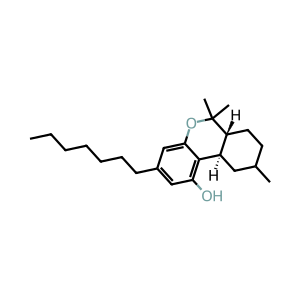
A semi-synthetic cannabinoid produced by hydrogenating THCP (tetrahydrocannabiphorol), giving it a seven-carbon (heptyl) side chain that boosts its receptor potency compared to standard HHC.
Last updated: 21 September 2026
HHCP at a glance
Naturally occurring
No
Psychoactive
Intoxicating
Cannabinoid type
Semi-synthetic cannabinoid
Discovery year
1942
Also known as
Hexahydrocannabiphorol, HHC-C7, CAS 3051970-87-4
Molecular formula
C23H36O2
CB1 receptor interaction
Agonist
CB2 receptor interaction
Potential agonist (not enough data)
What is HHCP?
HHCP is an intoxicating semi-synthetic cannabinoid and the hydrogenated counterpart of THCP. It does not occur naturally in cannabis and is produced through chemical synthesis or conversion of cannabinoid precursors. HHCP is generally considered around 5× as psychoactively potent as Delta-9-THC, although its actual potency in humans has not yet been reliably established.
HHCP has a seven-carbon (heptyl) side chain, two carbons longer than the five-carbon (pentyl) side chain of HHC. It can also be considered the fully hydrogenated form of THCP, with the double bond in THCP’s central ring removed. HHCP exists as 9R and 9S epimers, which differ considerably in their biological activity.
Commercial HHCP is produced synthetically or through hydrogenation of THCP and is generally supplied as a high-purity, viscous distillate. Its appearance is typically light or dark amber. Its saturated structure is expected to make HHCP more resistant to oxidation than THCP.
HHCP was first synthesised and studied in 1942 as part of early research into THC homologues, but remained largely obscure for decades. It entered the commercial cannabinoid market around 2021 and was first reported in Europe in 2022. Modern research remains limited, particularly regarding human effects, safety and pharmacokinetics.

How HHCP works in the human body
Peer-reviewed functional testing shows HHCP activates CB1 as a partial agonist, roughly 3x as potent as Delta-9-THC, with its 9R epimer producing meaningfully stronger activation than its 9S epimer. No dedicated CB2 or metabolism studies exist for HHCP, and it is not naturally formed in the human body.
CB1 receptor
The main cannabinoid receptor in the brain, responsible for THC’s intoxicating effects, is directly activated by HHCP. Persson measured EC50 values of 44.4 nM for 9R-HHCP, compared with 101 nM for 9R-HHC. This makes 9R-HHCP approximately 2.27x more potent than 9R-HHC in this G protein signalling assay.
Maximum responses were similar, 61% for 9R-HHCP versus 64% for 9R-HHC, showing that HHCP needs a lower concentration than HHC to activate CB1, but it does not produce a clearly greater maximum response in this assay.
Important to note is that the above describes receptor activation, not binding. No research has included binding details on HHCP. We can only extrapolate binding research from THCP, which binds ~33x better to the CB1 receptor compared to Delta-9-THC with an expected ~7 potency.
HHCP is theoretically estimated at around 3x the potency of Delta-9-THC, considering THCP’s 33x stronger CB1 binding and ~7x potency, alongside HHCP’s 2.27x greater CB1 functional potency than HHC and their similar maximum responses of 61% versus 64%.
CB2 receptor
The main cannabinoid receptor in the immune system, involved in regulating immune cell activity and inflammatory responses. Direct HHCP-specific CB2 binding affinity or functional activity has not yet been established.
Related cannabinoids suggest that CB2 activation is likely: 9R-HHC binds and activates CB2 substantially more strongly than its 9S epimer, while THCP, which shares HHCP’s seven-carbon side chain, shows very high CB2 binding affinity. These findings suggest that HHCP may also activate CB2 strongly, likely influencing immune-cell and inflammatory signalling, but its binding affinity, functional potency and maximum response at CB2 remain unverified.
Metabolism
Human liver-cell and urine research indicates that HHCP undergoes hydroxylation, further oxidation and glucuronidation. Hydroxylated metabolites and their glucuronides have been detected, including a metabolite identified as 9R-11-OH-HHCP. It’s very likely this metabolite interacts with the CB1 receptor strongly, producing a strong and long-lasting high. However this remains unverified by direct research.
✓
Human safety status
No direct data, considered likely safe based on similar cannabinoids
No human clinical trials or systematic toxicology studies exist for HHCP specifically. A retrospective poisoning case review found no dedicated human comparative studies on HHC-P receptor activation, describing this as a significant knowledge gap. Its likely safety profile is inferred from related semi-synthetic cannabinoids such as HHC, not from direct long-term human data, so a reliable safety profile cannot currently be established.
HHCP interactions with other compounds
HHCP can interact with other cannabinoids, common substances and medicines by changing their metabolism, blood exposure or biological effects. These interactions may increase, decrease or modify the effects of either compound, and can sometimes change how long those effects remain active in the body. Their strength and relevance can vary substantially depending on the specific combination, dose and route of administration.
Important disclaimer
This information is provided for educational and technical reference only. Interaction data can change as new research becomes available and may be incomplete or outdated. The real relevance of any interaction depends strongly on dose, route of administration, timing, formulation and individual metabolism. Readers should do their own research and consult a qualified healthcare professional before making decisions involving medicines, alcohol, nicotine, cannabinoids or other compounds. Elementra's products and information are intended for research, production and technical use only and are not intended for human consumption.
No Known Interactions Identified
Current Evidence
Limited Data
No sufficiently supported specific interactions between HHCP and other cannabinoids, common substances or medicines have currently been identified. HHCP-specific research has not yet shown that another compound meaningfully changes HHCP exposure or effects, or that HHCP meaningfully changes the exposure or effects of another compound. This should not be interpreted as HHCP having no interactions. Interactions may exist, but they have not yet been identified or characterized by research.
Related terms
Educational information only
This content does not constitute advice
All information in the Cannabinoid Knowledge Hub is provided solely for educational and scientific purposes. It does not constitute medical advice, usage advice, dosage guidance or instructions for mixing, combining or consuming substances.
Discussions of effects, interactions and risks are descriptive only and should not be interpreted as a recommendation or encouragement to use or combine any substance. Visitors are responsible for complying with all applicable laws and regulations in their country or jurisdiction. Nothing in the Knowledge Hub may be used to support illegal activity.
Read the full disclaimer