
What is D-Limonene?
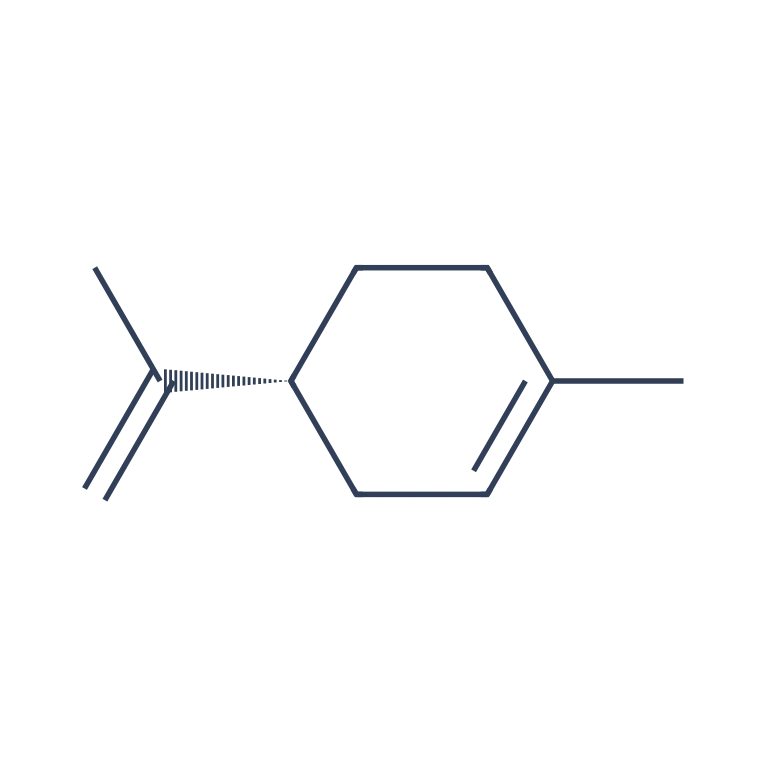
D-Limonene is a naturally occurring terpene with the molecular formula C10H16. Its structure contains a six-carbon ring with two carbon-carbon double bonds, making it different from open-chain monoterpenes such as β-Myrcene.
Limonene exists in two mirror-image forms. D-Limonene is the R-(+)-form and is the form most commonly found in citrus fruits and many other plants.
Reported effects
D-Limonene has been studied in both humans and animals, although the results depend strongly on dose, route of administration and whether it is used alone or together with other compounds.
Calming
Human & animal studiesD-Limonene has reduced anxiety-like behaviour in animal studies. In a controlled human study it also reduced some anxiety-related effects caused by THC, although D-Limonene by itself did not produce a clear calming effect compared with placebo.
Uplifting & energizing
Human & animal studiesSome research suggests that D-Limonene can increase alertness and activity. In a human fragrance study, inhaled D-Limonene increased subjective alertness, while animal research has also found increased movement at certain doses. These effects are not consistent across all studies.
Pain & inflammation
Preclinical studiesD-Limonene has reduced pain responses in several animal models, including models of muscular and facial pain. It has also reduced inflammatory signalling and inflammatory markers in both laboratory and animal studies.
Molecular targets
D-Limonene directly interacts with several molecular targets involved in nervous-system signalling, sensory processing and metabolism. Evidence supports activity at adenosine A2A receptors, TRPA1 channels, α7 nicotinic acetylcholine receptors and PPAR receptors.
Adenosine A2A receptor
The adenosine A2A receptor is involved in processes such as sleep, movement, inflammation and signalling between nerve cells.
D-Limonene directly binds to the A2A receptor and acts as an agonist. Laboratory experiments showed activation of several signals normally produced when this receptor is switched on.
Animal research also shows that blocking A2A receptors reduces several behavioural effects of D-Limonene, supporting the importance of this interaction.
TRP channels
TRP channels are sensory ion channels involved in processes such as pain, temperature and irritation.
D-Limonene directly activates TRPA1. At lower concentrations it can also reduce TRPA1 activation caused by oxidative stress.
This concentration-dependent behaviour may help explain why D-Limonene can produce irritation in some situations while reducing pain responses in others.
Nicotinic acetylcholine receptor
Nicotinic acetylcholine receptors are ion channels involved in communication between nerve cells and in processes such as attention, memory and muscle signalling.
D-Limonene directly inhibits the human α7 nicotinic acetylcholine receptor in laboratory experiments.
The interaction is weaker than that of several other monoterpenes tested under the same conditions, and its importance at normal exposure levels remains uncertain.
PPAR receptors
PPAR receptors regulate gene activity involved in energy use, fat metabolism and inflammatory signalling.
D-Limonene activates PPAR-α signalling in laboratory and animal studies. More recent research has also demonstrated direct interaction between D-Limonene and PPARγ.
In the PPARγ study, D-Limonene reduced activity of the PPARγ-related metabolic pathway rather than behaving as a simple receptor agonist. Its effects on different PPAR subtypes therefore appear to differ.