
What is α-Terpineol?
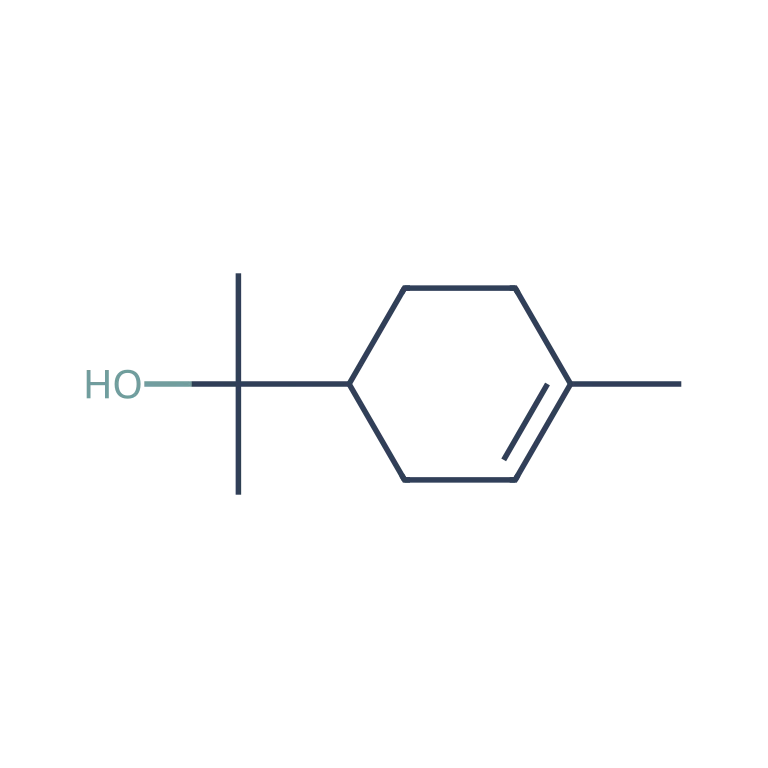
α-Terpineol is a naturally occurring terpene with the molecular formula C10H18O. Its structure contains a six-carbon ring, one carbon-carbon double bond and an alcohol group, placing it within the monoterpene alcohol family.
Several different terpineols exist, including α-Terpineol, β-Terpineol and terpinen-4-ol. Although their names are similar, the position of their alcohol group and double bond differs, giving each compound its own chemical and biological properties.
Reported effects
α-Terpineol has been studied mainly in animal and laboratory models. Research supports calming effects on the nervous system, pain and inflammation reduction, and relaxation of smooth muscle.
Calming
Animal studiesα-Terpineol has reduced locomotor activity and increased sedative-like behaviour in animal experiments. Laboratory research also shows that it can strengthen inhibitory GABA-A signalling, providing a possible mechanism for these calming effects.
Pain & inflammation
Preclinical studiesα-Terpineol has reduced pain responses in several animal models, including inflammatory, nerve-related and chronic muscle pain. It has also reduced inflammatory signals such as TNF-α and IL-1β and decreased inflammatory immune-cell activity.
Muscle relaxation
Laboratory studiesα-Terpineol can directly relax smooth muscle in isolated tissue. Concentration-dependent relaxation has been observed in stomach and blood-vessel muscle, including tissue that had first been contracted using chemical stimulation.
Molecular targets
The clearest direct molecular target identified for α-Terpineol is the GABA-A receptor, one of the main inhibitory signalling systems in the nervous system.
GABA-A receptor
GABA-A is one of the main inhibitory receptors in the brain and helps reduce excessive electrical activity between nerve cells.
α-Terpineol directly increases GABA-A receptor activity when GABA is present. This means it acts as a positive modulator rather than simply activating the receptor by itself.
This interaction provides a plausible molecular mechanism for the calming and sedative-like effects observed with α-Terpineol in animal studies.