
11-Hydroxy-THC
A psychoactive metabolite formed when the liver metabolizes Delta-9-THC, produced primarily via metabolism after oral cannabis consumption.
Last updated: 21 September 2026
11-Hydroxy-THC at a glance
Naturally occurring
No
Psychoactive
Intoxicating
Cannabinoid type
Metabolite
Discovery year
1970
Also known as
11-Hydroxy-Δ9-tetrahydrocannabinol, 11-OH-THC, CAS 36557-05-8
Molecular formula
C21H30O3
CB1 receptor interaction
Agonist
CB2 receptor interaction
Potential agonist (not enough data)
What is 11-Hydroxy-THC?
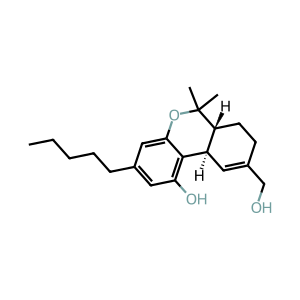
11-Hydroxy-THC is an active metabolite of Delta-9-THC and an important contributor to its intoxicating effects. It is an intoxicating cannabinoid metabolite, generally considered around 2× as psychoactively potent as Delta-9-THC. It is formed after Delta-9-THC enters the body, with particularly substantial formation after oral consumption.
11-Hydroxy-THC retains the basic structure and five-carbon (pentyl) side chain of Delta-9-THC, but one of THC’s methyl groups is converted into a hydroxymethyl group at the 11-position. This relatively small structural change preserves strong psychoactive activity while giving the molecule somewhat different chemical properties. Related metabolites also exist for other THC isomers, such as 11-Hydroxy-Delta-8-THC.
For research and analytical use, 11-Hydroxy-THC is produced synthetically rather than isolated from biological material. The purified compound is a solid and is also commonly supplied as a reference solution. Analytical material can remain stable for at least four years when stored at approximately -20°C, while specific degradation products during normal storage or ageing are not well established.
11-Hydroxy-THC was identified as a major THC metabolite around 1970, followed quickly by human studies confirming its presence and strong psychoactive effects. It is now one of the best-established active cannabinoid metabolites and is important for understanding why oral Delta-9-THC can differ from inhaled THC. Research is relatively mature compared with most minor cannabinoids, although precise potency and individual differences in its formation remain areas of continued study.
How 11-Hydroxy-THC works in the human body
11-Hydroxy-THC produces its effects mainly through strong CB1 receptor interaction and psychoactive signalling in the brain. Its apparent CB1 binding is exceptionally high, while functional and human evidence suggests a theoretical psychoactive potency of approximately 2x that of Delta-9-THC.
It also interacts with drug-metabolising enzymes and is further converted into inactive metabolites, which influence how long it remains detectable in the body.
CB1
11-Hydroxy-THC acts as a CB1 agonist and shows exceptionally high binding affinity, with a reported Ki of approximately 0.37 nM, compared with 35 nM for Delta-9-THC in the same assay. This corresponds to roughly 95x stronger apparent CB1 binding affinity. However this unusually high affinity cannot be translated directly into psychoactive potency.
Functional activity is considerably less extreme and depends on the signalling pathway measured. In cAMP signalling, 11-Hydroxy-THC had an EC50 of approximately 11 nM versus 5.2 nM for Delta-9-THC, while its maximum response was 28% versus 70%. In another CB1 signalling pathway, both compounds reached approximately the same maximum response, although 11-Hydroxy-THC required higher concentrations.
Whole-body evidence points toward stronger effects than these functional assays alone suggest. A controlled human study using equal 1 mg intravenous doses found approximately 2x greater peak subjective intensity from 11-Hydroxy-THC, while another human study found the two compounds approximately equally potent. Animal studies have also reported effects ranging from roughly equal potency to several times greater potency depending on the response measured.
Considering the 95x apparent CB1 affinity, the much smaller differences in functional signalling, the approximately 1 to 2x potency observed in direct human comparisons, and stronger effects in several animal studies, a theoretical psychoactive potency of approximately 2x Delta-9-THC is a reasonable overall estimate. The extreme binding affinity supports greater potency but is not weighted proportionally because receptor binding alone does not predict the strength of the resulting psychoactive effect.
CB2
The main cannabinoid receptor in the immune system, involved in regulating immune cell activity and inflammatory responses. Comparable receptor data indicate 11-Hydroxy-THC’s CB2 affinity is roughly comparable to THC’s, but no dedicated functional studies isolate its immune signalling effects, so any CB2-mediated anti-inflammatory activity is inferred rather than directly researched.
Metabolism
11-Hydroxy-THC is further metabolised, including conversion toward THC-COOH, an inactive metabolite with little meaningful cannabinoid-receptor activity. Additional metabolism convert 11-Hydroxy-THC and related metabolites into forms that can be eliminated from the body.
✓
Human safety status
No direct data, considered likely safe based on similar cannabinoids
No dedicated human toxicology trials exist for 11-Hydroxy-THC alone, since it always forms alongside THC after cannabis use. As a long-established, natural THC metabolite, it is generally regarded as safe, with its safety profile inferred from long-term user reports, THC pharmacology and animal potency studies rather than independent human data.
11-Hydroxy-THC interactions with other compounds
11-Hydroxy-THC can interact with other cannabinoids, common substances and medicines by changing their metabolism, blood exposure or biological effects. These interactions may increase, decrease or modify the effects of either compound, and can sometimes change how long those effects remain active in the body. Their strength and relevance can vary substantially depending on the specific combination, dose and route of administration.
Important disclaimer
This information is provided for educational and technical reference only. Interaction data can change as new research becomes available and may be incomplete or outdated. The real relevance of any interaction depends strongly on dose, route of administration, timing, formulation and individual metabolism. Readers should do their own research and consult a qualified healthcare professional before making decisions involving medicines, alcohol, nicotine, cannabinoids or other compounds. Elementra's products and information are intended for research, production and technical use only and are not intended for human consumption.
Cannabinoids
CBD
Human study
11-OH-THC exposure can increase up to about 6.2x
CBD can substantially increase 11-OH-THC exposure when taken with oral Delta-9-THC. In controlled human research, 450 mg CBD increased total 11-OH-THC exposure about 6.24x, while 30 mg increased it about 1.89x. A 10 mg CBD dose produced no significant change, showing that the interaction is strongly dose-dependent. This pharmacokinetic effect is separate from CBD’s reported negative allosteric modulation of CB1 receptors, which can reduce cannabinoid receptor signalling through a different mechanism.
Common substances
Alcohol
Human studies
Peak 11-OH-THC exposure can increase, but findings are mixed
Alcohol has produced inconsistent effects on 11-OH-THC. In one controlled vaporization study, alcohol increased peak blood concentrations by roughly 20% to 32%, depending on the THC dose. Another controlled study found no significant change in 11-OH-THC concentrations or pharmacokinetics, so the interaction appears to depend on dosing conditions and route of administration.
Medicines
Ketoconazole
Human study
11-OH-THC exposure increases about 3.6x
Ketoconazole substantially increases 11-OH-THC concentrations. In a controlled human interaction study, total exposure increased about 3.6x and peak concentration about 3.1x. This is consistent with inhibition of CYP3A4-mediated clearance of 11-OH-THC.
Fluconazole
Human study
11-OH-THC exposure increases about 2.5x
Fluconazole substantially increases 11-OH-THC exposure. Human pharmacokinetic data show approximately a 2.5x increase in total exposure and a 2.1x increase in peak concentration, consistent with inhibition of enzymes involved in further 11-OH-THC metabolism.
Rifampicin
Human study
11-OH-THC exposure decreases about 87%
Rifampicin strongly reduces 11-OH-THC exposure by increasing the activity of drug-metabolizing enzymes. Controlled human research found approximately an 87% reduction in total exposure and an 85% to 87% reduction in peak concentration, indicating substantially faster removal of 11-OH-THC.
Related terms
Educational information only
This content does not constitute advice
All information in the Cannabinoid Knowledge Hub is provided solely for educational and scientific purposes. It does not constitute medical advice, usage advice, dosage guidance or instructions for mixing, combining or consuming substances.
Discussions of effects, interactions and risks are descriptive only and should not be interpreted as a recommendation or encouragement to use or combine any substance. Visitors are responsible for complying with all applicable laws and regulations in their country or jurisdiction. Nothing in the Knowledge Hub may be used to support illegal activity.
Read the full disclaimer