
THCV
A THC homologue with a three-carbon (propyl) side chain instead of THC’s five-carbon (pentyl) chain, occurring naturally in cannabis in trace amounts.
Last updated: 21 September 2026
THCV at a glance
Naturally occurring
Yes
Psychoactive
Dose-dependent
Cannabinoid type
Phytocannabinoid
Discovery year
1942
Also known as
Tetrahydrocannabivarin, THC-C3, CAS 31262-37-0
Molecular formula
C19H26O2
CB1 receptor interaction
Antagonist
CB2 receptor interaction
Agonist
What is THCV?
THCV is a naturally occurring phytocannabinoid, a varin cannabinoid and the three-carbon homologue of Delta-9-THC. It occurs especially in some cannabis populations from Africa and South Asia, usually alongside its acidic precursor THCVA. THCV has dose-dependent psychoactive properties: typical doses are generally considered non-intoxicating, while higher doses may produce mild THC-like intoxication at roughly 0.2 to 0.25× the potency of Delta-9-THC.
THCV has the same basic THC structure as Delta-9-THC but contains a three-carbon (propyl) side chain instead of the five-carbon (pentyl) side chain of Delta-9-THC. This shorter side chain substantially changes its biological properties and distinguishes it from conventional five-carbon THC.
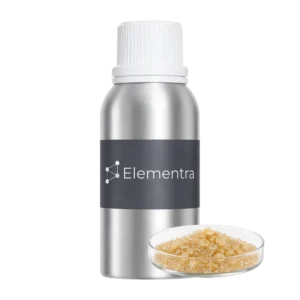
Commercial THCV is generally produced through extraction, purification or synthesis and is supplied as a high-purity concentrate. It has a strong tendency to crystallise and generally becomes fully crystallized at room temperature. Commercial material may appear purple when cool, shifting toward brown or amber crystals as it is warmed, before becoming a very dark, viscous liquid under stronger heating.
THCV was first detected in cannabis in 1970 and isolated from a Pakistani cannabis tincture in 1971. Scientific interest has increased considerably in recent years, particularly around metabolism, appetite and energy regulation. This has also led to widespread marketing as “diet weed”, although human evidence for meaningful appetite suppression or weight loss remains limited.

How THCV works in the human body
THCV primarily blocks CB1 signalling while acting as a partial CB2 agonist, and also influences 5-HT1A, TRP channels and GPR55. Human studies suggest little THC-like intoxication at studied oral doses, while metabolism likely produces 11-OH-THCV, a metabolite whose psychoactive activity in humans remain unknown.
CB1 receptor
The main cannabinoid receptor in the brain, responsible for THC’s intoxicating effects. Human-receptor research found THCV and Delta-9-THC to have approximately 1.0x the same CB1 binding affinity, showing that THCV can occupy the receptor about as effectively as Delta-9-THC.
Unlike Delta-9-THC, THCV generally blocks CB1 signalling rather than activating it. Functional research found little to no CB1 agonist activity and showed that THCV can give activation like other CB1 agonists. However, other assays found THCV could activate specific pathways such as ERK and β-arrestin signalling, indicating that its CB1 behaviour is pathway-dependent.
This CB1 antagonism can reduce some Delta-9-THC effects in humans. In a controlled study, THCV alone was subjectively indistinguishable from placebo, while 9 of 10 participants experienced subsequent Delta-9-THC as less intense. THCV also reduced the THC-related increase in heart rate and prevented impairment in one memory measure, although some other effects were unchanged or increased.
CB2 receptor
The main cannabinoid receptor in the immune system, involved in regulating immune cell activity and inflammatory responses. Direct human-receptor research found that THCV has approximately 1.1x stronger CB2 binding affinity than Delta-9-THC, meaning their binding strength is very similar.
THCV acts as a partial CB2 agonist, although its functional behaviour varies between experimental systems. Earlier research has also observed antagonist-like behaviour under different testing conditions, suggesting that its effect can depend on how CB2 signalling is measured.
CB2 activation may reduce inflammatory signalling and contribute to pain-reducing effects. Animal research supports CB2 involvement in some THCV effects, but specific CB2 effects have not yet been confirmed in humans.
5-HT1A receptor
The 5-HT1A serotonin receptor helps regulate mood, stress, cognition and emotional processing. THCV does not strongly activate this receptor by itself, but instead appears to enhance its response to other agonists. In rat brain tissue, 100 nM THCV increased the potency of the 5-HT1A agonist 8-OH-DPAT by approximately 240.9x, without increasing its maximum effect. Experiments using human 5-HT1A receptors also confirmed enhanced receptor activation, although there THCV mainly increased the maximum response rather than potency. This is classifies THCV acting as a positive allosteric modulator of 5-HT1A signalling.
Animal research suggests this mechanism can produce meaningful neurological effects. In rat models, THCV reduced several schizophrenia-like behavioural and cognitive changes, and blocking 5-HT1A prevented or reduced some of these effects. This confirms a direct contribution from THCV to enhanced 5-HT1A signalling, although specific effects have not been confirmed in humans.
TRP channels
TRP channels are ion channels involved in pain, temperature and sensory signalling. THCV directly affects several of these channels, including TRPV1, TRPV2, TRPV3 and TRPV4, while it inhibits TRPM8.
THCV activates and then desensitizes TRPV1, a channel involved in heat and pain signalling. Initial activation can increase sensory signalling, while the later desensitization makes the channel less responsive and could therefore contribute to reduced pain signalling.
THCV also activates and desensitizes TRPV2. This initially increases calcium entry and cellular signalling, while subsequent desensitization reduces the channel’s responsiveness and could contribute to pain-reducing and sensory effects.
At TRPV3, THCV acts as an activator. This channel is involved in warmth detection and sensory signalling, so activation could increase warmth-related signalling. Repeated activation can also make the channel less responsive over time.
THCV activates TRPV4, which is involved in temperature, pressure and pain-related signalling. This increases calcium signalling inside cells and could enhance certain sensory responses.
THCV inhibits TRPM8, a channel involved in sensing cold temperatures and cooling sensations. This reduces TRPM8 activity and could decrease cold-sensitive signalling and sensitivity to cold-related discomfort or pain.
These TRP interactions are established in laboratory research, but their contribution to THCV’s specific effects in humans remains uncertain.
GPR55 receptor
GPR55 is a receptor involved in pain, metabolism and cellular signalling. THCV appears to have a mixed modulatory effect at GPR55 rather than behaving as a simple agonist or antagonist.
THCV can weakly activate GPR55 on its own, but it can also reduce stronger GPR55 signalling triggered by LPI (the receptor’s natural agonist). This suggests that THCV may regulate GPR55 activity by producing mild activation while limiting stronger stimulation from other molecules.
Through this mechanism, THCV could potentially influence pain signalling and metabolic processes such as appetite regulation. However, the contribution of GPR55 to THCV’s effects in humans has not yet been established.
Metabolism
Human liver-cell research confirms that Delta-9-THCV is extensively metabolized, with THCV-COOH identified as a major breakdown product. This metabolite has also been detected in human urine after cannabis exposure.
Formation of 11-OH-THCV as an intermediate is biologically plausible and would resemble the conversion of Delta-9-THC into 11-OH-THC. However, 11-OH-THCV has not yet been sufficiently confirmed or characterized in humans, and whether it remains pharmacologically active or psychoactive is unknown.
✓
Human safety status
No short term harm found, long term data not yet established
Direct human studies include five days of oral THCV in healthy adults and a 13-week controlled trial using 5 mg twice daily in people with type 2 diabetes. THCV was well tolerated in both studies, with no clear short term safety signal attributable to THCV. Sample sizes and exposure periods remain insufficient to establish uncommon or long term effects.
THCV interactions with other compounds
THCV can interact with other cannabinoids, common substances and medicines by changing their metabolism, blood exposure or biological effects. These interactions may increase, decrease or modify the effects of either compound, and can sometimes change how long those effects remain active in the body. Their strength and relevance can vary substantially depending on the specific combination, dose and route of administration.
Important disclaimer
This information is provided for educational and technical reference only. Interaction data can change as new research becomes available and may be incomplete or outdated. The real relevance of any interaction depends strongly on dose, route of administration, timing, formulation and individual metabolism. Readers should do their own research and consult a qualified healthcare professional before making decisions involving medicines, alcohol, nicotine, cannabinoids or other compounds. Elementra's products and information are intended for research, production and technical use only and are not intended for human consumption.
Cannabinoids
Delta-9-THC
Human study
Some Delta-9-THC effects decrease while others increase
THCV altered several effects of Delta-9-THC in a small controlled human study. After five days of 10 mg oral THCV, THCV reduced the Delta-9-THC-induced increase in heart rate, and nine of ten participants described the Delta-9-THC experience as weaker or less intense. However, memory intrusions increased when the cannabinoids were combined, showing that the interaction is mixed rather than simply inhibitory. The study included only ten participants, so the findings require confirmation in larger human studies.
Medicines
Tolbutamide
Enzyme study
Tolbutamide blood exposure may increase
THCV inhibits CYP2C9-mediated metabolism of tolbutamide in laboratory testing. By slowing the breakdown of tolbutamide, THCV could cause more of the medicine to remain in the bloodstream, increasing its exposure and potentially strengthening or prolonging its glucose-lowering effect. The resulting increase in blood exposure has not yet been measured or confirmed in humans.
Related terms
Educational information only
This content does not constitute advice
All information in the Cannabinoid Knowledge Hub is provided solely for educational and scientific purposes. It does not constitute medical advice, usage advice, dosage guidance or instructions for mixing, combining or consuming substances.
Discussions of effects, interactions and risks are descriptive only and should not be interpreted as a recommendation or encouragement to use or combine any substance. Visitors are responsible for complying with all applicable laws and regulations in their country or jurisdiction. Nothing in the Knowledge Hub may be used to support illegal activity.
Read the full disclaimer