
What is β-Caryophyllene?
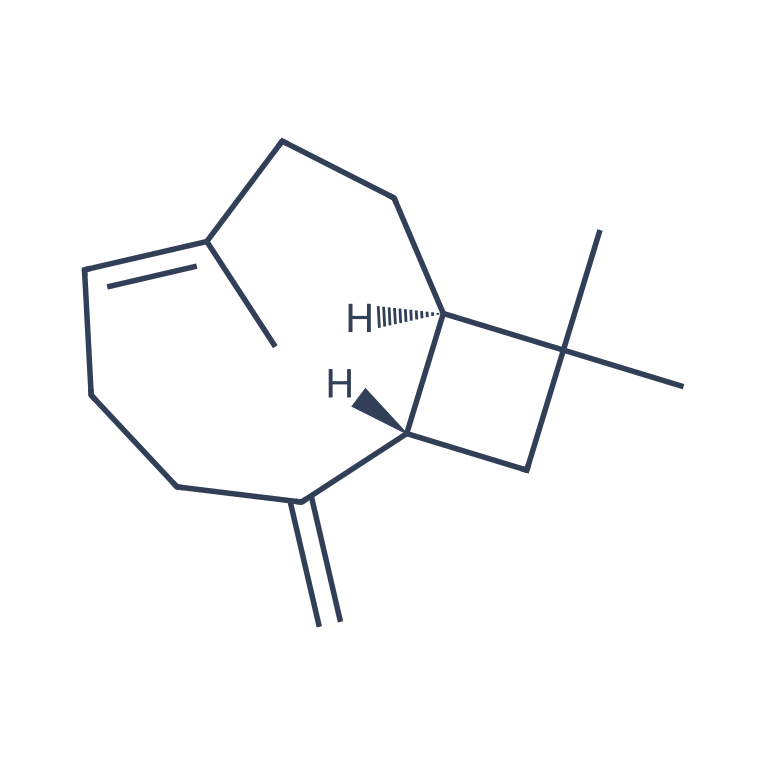
β-Caryophyllene is a naturally occurring terpene with the molecular formula C15H24. It is larger than monoterpenes such as β-Myrcene and has a structure made up of two connected carbon rings. One of these is an unusual four-carbon ring that helps distinguish β-Caryophyllene from many other common terpenes.
The form most commonly found in nature is trans-β-Caryophyllene. When exposed to air, β-Caryophyllene can slowly change into other compounds, with Caryophyllene Oxide forming as its main oxidation product.
Reported effects
β-Caryophyllene has been studied extensively in animal and laboratory models. Human evidence remains limited, so its reported effects should still be considered preliminary rather than clinically established.
Calming
Animal studiesβ-Caryophyllene has reduced anxiety-like behaviour in several mouse studies. These findings suggest a possible calming effect, although this has not yet been clearly demonstrated in humans.
Pain & inflammation
Preclinical studiesβ-Caryophyllene has reduced pain responses and inflammatory activity in multiple animal and laboratory studies. CB2 receptor activation appears to play an important role in these effects.
Cognitive support
Animal studiesβ-Caryophyllene has improved memory and learning performance in several animal models involving inflammation, ageing or sleep deprivation. These findings have not yet been confirmed in controlled human studies.
Molecular targets
β-Caryophyllene is unusual among common cannabis terpenes because it can directly interact with the endocannabinoid system. Its best-established molecular target is the CB2 receptor, while research also shows activity involving PPAR receptors.
CB2 receptor
The CB2 receptor is part of the endocannabinoid system and is found mainly in immune cells and other tissues outside the brain.
β-Caryophyllene directly binds to CB2, with a reported Ki of approximately 155 nM, and acts as an agonist. This means it can activate the receptor rather than simply attaching to it.
CB2 activation is linked to many of the pain and inflammation effects reported for β-Caryophyllene in animal studies. Unlike THC, β-Caryophyllene does not significantly activate CB1, so this mechanism is not expected to produce a THC-like intoxicating effect.
Not every laboratory system has detected the same level of CB2 activity, so the measured strength of the response appears to depend partly on the experimental method used.
PPAR receptors
PPAR receptors help regulate processes such as inflammation, energy use and fat metabolism inside cells.
β-Caryophyllene has been shown to activate PPAR-α. Research also points to involvement of PPAR-γ in several of its biological effects.
Animal and cell studies suggest that these receptors may contribute to the anti-inflammatory and metabolic effects of β-Caryophyllene. Evidence for PPAR-α activity is stronger, while the role of PPAR-γ appears to depend more on the tissue and experimental model being studied.