
What is β-Eudesmol?
β-Eudesmol is a naturally occurring terpene with the molecular formula C15H26O. Its structure contains two connected carbon rings and an alcohol group, placing it within the sesquiterpene alcohol family.
β-Eudesmol belongs to the eudesmane group of sesquiterpenes. Its relatively large and compact structure makes it less volatile than many smaller monoterpenes.
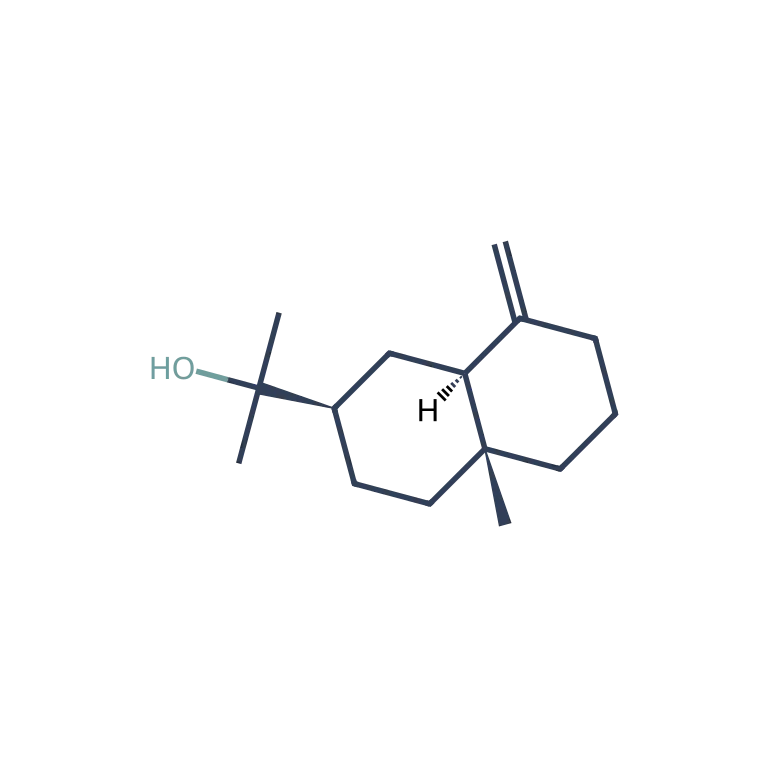
Reported effects
β-Eudesmol has been studied in both humans and preclinical models. Research suggests effects on the body's response to stress and on inflammatory signalling, although the evidence for directly noticeable effects remains limited.
Calming
Human studyIn a placebo-controlled study in healthy adults, β-Eudesmol reduced the increase in a marker of sympathetic nervous-system activity during an acute mental stress test. However, participants did not report significantly lower anxiety and cortisol levels were unchanged, so evidence for a directly noticeable calming effect remains limited.
Pain & inflammation
Preclinical studiesβ-Eudesmol has reduced several inflammatory responses in laboratory and animal studies. It has lowered inflammatory signals such as IL-6, IL-1β and TNF-α and reduced mast-cell activation. Direct evidence for pain reduction from isolated β-Eudesmol is less established than the evidence for its anti-inflammatory activity.
Molecular targets
The clearest direct molecular targets identified for β-Eudesmol are TRPA1 and nicotinic acetylcholine receptor channels.
TRP channels
TRP channels are sensory ion channels involved in processes such as pain, temperature and irritation.
β-Eudesmol directly activates TRPA1. Laboratory experiments showed increased calcium entry after exposure to β-Eudesmol, demonstrating functional activation of the channel.
Animal experiments further confirmed the importance of TRPA1. Several effects of β-Eudesmol were strongly reduced when TRPA1 was blocked or genetically removed.
TRPA1 can therefore be considered a well-supported direct molecular target of β-Eudesmol.
Nicotinic acetylcholine receptor
Nicotinic acetylcholine receptors are ion channels involved in communication between nerves and muscles.
β-Eudesmol directly blocks nicotinic acetylcholine receptor channels at the neuromuscular junction.
Patch-clamp experiments showed that β-Eudesmol reduces both channel opening time and opening frequency and can block the receptor channel in both its open and closed states.
This makes nicotinic acetylcholine receptors one of the clearest direct molecular targets identified for β-Eudesmol.