
What is β-Myrcene?
β-Myrcene is a naturally occurring volatile compound with the molecular formula C10H16. Unlike many other common terpenes, its carbon structure forms an open chain rather than a ring. It also contains several carbon-carbon double bonds.
β-Myrcene can slowly change over time when exposed to air, light or heat. Because of this, the composition of myrcene-rich material may gradually shift during long storage or processing.
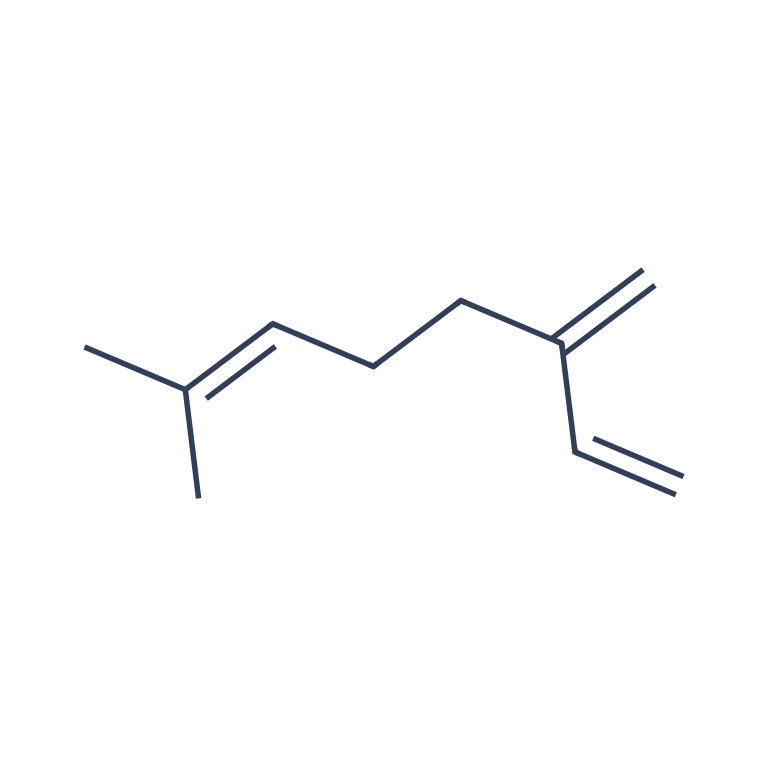
Role in cannabis
β-Myrcene is one of the most common major terpenes in cannabis. In many cultivars it is present at higher concentrations than any other monoterpene, although the exact amount can vary widely between plants and chemotypes.
Cannabis varieties with high β-Myrcene levels often also contain notable amounts of α-Pinene and β-Pinene. Large terpene profiling studies have identified a distinct myrcene-rich cannabis group, showing that β-Myrcene is one of the compounds that can help separate different cannabis chemotypes from each other.
Reported effects
β-Myrcene has been studied mainly in animal and laboratory models. Human research is still limited, so these effects should be viewed as preliminary rather than clinically established.
Calming
Animal studiesβ-Myrcene has shown calming and sedative-like effects in animal studies. These findings suggest that it may reduce general activity and promote a more relaxed state, although this has not been clearly demonstrated in humans.
Sedating
Human pilot studySedating effects have been reported in animal research. In a small placebo-controlled human study, 15 mg of pure β-Myrcene also increased errors in divided attention and reduced performance on some simulated driving tasks.
Pain & inflammation
Preclinical studiesβ-Myrcene has reduced pain responses and inflammatory signalling in several animal and laboratory models. These findings support a possible role in both pain regulation and inflammatory responses, but controlled human studies are still lacking.
Muscle relaxation
Animal studiesβ-Myrcene has shown muscle-relaxing effects in animal experiments. It has also increased the effects of other compounds that reduce muscle activity, suggesting that it may influence pathways involved in muscle relaxation.
Molecular targets
The clearest direct molecular targets identified for β-Myrcene are TRP channels involved in pain and sensory signalling. Direct activity has been demonstrated at both TRPV1 and TRPA1, although the strength of these responses varies between experimental models and concentrations.
TRP channels
TRP channels are sensory ion channels involved in processes such as pain, temperature and irritation.
β-Myrcene directly activates TRPV1 in laboratory experiments. It produced calcium entry and measurable electrical currents through cells expressing the channel.
β-Myrcene can also activate TRPA1, although higher concentrations were required in some experiments.
Not every experimental system has reproduced these effects, suggesting that TRP activity depends strongly on concentration and the type of cells being studied.