
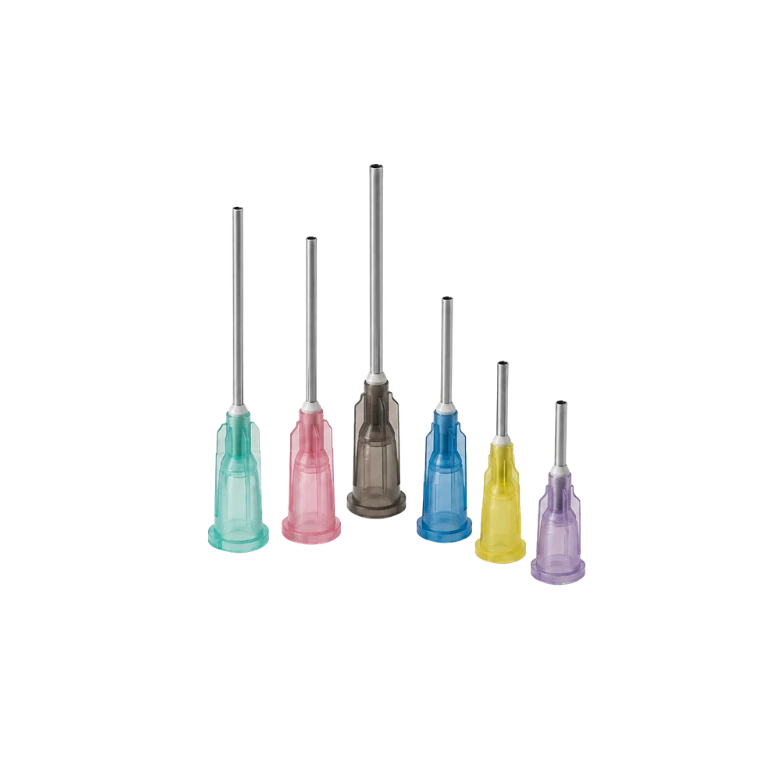
Usage
Blunt tip needles attach to a syringe and provide a narrow, controlled outlet for transferring and dispensing cannabinoid distillates, terpene formulations and other liquid blends. They are commonly connected through a Luer Lock fitting, allowing the needle to be securely attached to compatible syringes.
Blunt tip needles are available in different gauges, usually indicated by the letter G. The gauge describes the diameter of the needle. A higher gauge number means a smaller needle opening, while a lower gauge number means a larger opening. For example, a 12G needle has a considerably larger internal diameter than a 14G or 16G needle. Optimal sizes are for cannabinoid blends are between 12G and 16G.
The gauge used depends mainly on the viscosity of the formulation and the size of the opening being filled. Thick cannabinoid distillates are generally handled with a larger internal diameter and therefore a lower gauge number. Lower-viscosity formulations can pass through smaller openings, which can provide finer control during filling. Wider needles are easier to use with viscous material, although their larger internal volume also results in more residual material remaining inside the needle after use.
When working with viscous distillates, both the syringe and the blunt tip needle are normally warmed before use. Heating only the syringe while leaving the needle cold can cause the distillate to cool and thicken as soon as it enters the needle. In practice, the complete product-contact pathway is kept warm enough for the formulation to move without requiring excessive force.
Resistance is especially noticeable when drawing thick distillate into the syringe. If substantial pulling force is required, the formulation or needle is usually not warm enough, or the needle opening is too small for the viscosity of the material. Excessive pulling force can cause the plunger seal to detach or lose contact with the syringe barrel. In practice, this is managed by balancing the temperature of the syringe and formulation, the viscosity of the material and the speed at which the plunger is pulled.
Blunt tip needles can be reused, but the narrow internal channel makes complete cleaning difficult. Thick distillate can remain inside the needle and may solidify or crystallize after cooling. Internal cleaning requires the needles being submerged in cleaning alcohol in an ultrasonic cleaner. Because blunt tip needles are relatively inexpensive, they are commonly treated as disposable components when cross-contamination or cleaning effort would be a concern.
Advantages
Low-cost and simple way to precisely dispense material from a syringe
Narrow outlet provides good control when filling cartridges, bottles and other small openings
Available in different gauges for different formulation viscosities and dispensing requirements
Luer Lock compatibility makes needles easy to securely attach, remove and replace
Disadvantages
Distillate can cool, thicken or crystallize inside the needle and block the internal channel
Can only be cleaned with an ultrasonic cleaner
Incorrect gauge selection can make dispensing unnecessarily difficult or increase residue
Material suitability
Specification notes
Luer Lock connection compatible with the syringe being used
Gauge size suitable for the formulation
Needle length suitable for the intended container or filling application
Material compatible with cannabinoids, terpenes and the intended processing temperature
Safety notes
Blunt tip needles are intended only for processing, transferring and dispensing formulations and are absolutely not intended for injection into humans or animals
Don't force highly viscous material through the needle. Increase the temperature appropriately or use a larger internal diameter if excessive pressure is required
Heated blunt tip needles can become hot enough to cause burns and should be allowed to cool before direct handling
Inspect the Luer Lock connection before dispensing to make sure the needle is securely attached
Clean, disinfect and fully dry reusable needles before product contact, and avoid reuse between different formulations when cross-contamination is a concern