
Delta-9-THC
The primary psychoactive phytocannabinoid in cannabis, responsible for the plant’s intoxicating “high”.
Last updated: 21 September 2026
Delta-9-THC at a glance
Naturally occurring
Yes
Psychoactive
Intoxicating
Cannabinoid type
Phytocannabinoid
Discovery year
1964
Also known as
THC, Δ9-Tetrahydrocannabinol, Dronabinol, CAS 1972-08-3
Molecular formula
C21H30O2
CB1 receptor interaction
Agonist
CB2 receptor interaction
Agonist
What is Delta-9-THC?
Delta-9-THC is an intoxicating phytocannabinoid and the commonly known psychoactive cannabinoid associated with cannabis. It occurs naturally across cannabis chemotypes, particularly THC-dominant varieties, although fresh plant material contains most of its potential Delta-9-THC as the acidic precursor THCA. Delta-9-THC levels increase as THCA decarboxylates during drying, ageing or heating.
Delta-9-THC contains a five-carbon (pentyl) side chain and serves as the reference structure for many THC homologues and positional isomers. The predominant natural form is trans-(6aR,10aR)-Delta-9-THC. Cis-Delta-9-THC also occurs naturally in some cannabis varieties, particularly certain low-THC fibre hemp varieties, but is much less commonly encountered.
Commercial Delta-9-THC is generally obtained from cannabis extracts, where naturally abundant THCA is converted into Delta-9-THC through decarboxylation during processing. It is commonly refined into a high-purity distillate, typically yellow or amber with a thick, viscous consistency. Delta-9-THC is relatively susceptible to oxidation and degradation, with CBN being one of its best-known ageing products alongside several other oxidised derivatives.
The structure of Delta-9-THC was determined in 1964, a major milestone in cannabinoid science. It has since become the most extensively studied intoxicating cannabinoid and the main reference point for comparing the potency and properties of newer THC-related compounds. Delta-9-THC is also one of the most heavily regulated cannabinoids worldwide, and medical and recreational access varies substantially between jurisdictions.
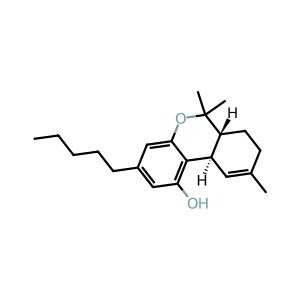
How Delta-9-THC works in the human body
Delta-9-THC primarily acts as a partial agonist at CB1 and CB2 receptors, with CB1 activation producing its confirmed intoxicating and cognitive effects. It also interacts with GPR18 and several TRP ion channels. Metabolism produces 11-OH-THC, an active psychoactive metabolite, relevant after oral exposure.
CB1 receptor
The main cannabinoid receptor in the brain, responsible for THC’s intoxicating effects, is directly activated by Delta-9-THC as a partial agonist, meaning it activates the receptor but produces a lower maximum response than a full agonist. One human-receptor study measured a CB1 Ki of 18 nM, while pooled human data estimate approximately 25.1 nM, showing some assay-dependent variation. CB1 activation reduces cAMP signalling, alters calcium and potassium channel activity and decreases neurotransmitter release. In humans this produces confirmed intoxication, altered perception, memory impairment, changes in coordination and other central effects.
CB2 receptor
The main cannabinoid receptor in the immune system, involved in regulating immune cell activity and inflammatory responses. Delta-9-THC is also a partial CB2 agonist. A human-receptor study measured a CB2 Ki of 42 nM, while pooled human data estimate approximately 35.2 nM. CB2 activation can modify immune-cell signalling and inflammatory responses, although the overall immune effects of isolated Delta-9-THC in humans are less clearly established than its CB1 effects.
Glycine receptors
Glycine receptors are ion channels that reduce nerve signalling and play an important role in pain processing and motor control. Delta-9-THC acts as a positive allosteric modulator of glycine receptors, the α1 and α3 subtypes. Rather than activating these receptors on its own, Delta-9-THC binds to a separate site and strengthens the response produced by glycine, allowing greater inhibitory signalling. Structural research has directly visualized Delta-9-THC interacting with the glycine receptor and confirmed this mechanism.
This mechanism appears especially relevant to pain. Animal research found that the α3 glycine receptor contributes substantially to the pain-reducing effects of Delta-9-THC, with these effects strongly reduced when this receptor mechanism was disrupted. This suggests that part of Delta-9-THC’s effect can occur through glycine receptors independently of CB1 and CB2.
TRP channels
TRP channels are ion channels involved in pain, temperature and sensory signalling. Delta-9-THC directly activates several of these channels, including TRPA1 and TRPV2, while it inhibits TRPM8.
Delta-9-THC directly activates TRPA1, a channel involved in detecting irritating stimuli, pain and temperature changes. This activation could contribute to changes in pain perception and other sensory responses, although its contribution to the effects of Delta-9-THC in humans has not been established.
Delta-9-THC directly activates TRPV2, with an EC50 of approximately 0.65 µM reported in functional research. TRPV2 allows calcium to enter cells and is involved in sensory, pain and cellular signalling. Its activation could therefore contribute to some pain-related or sensory effects of Delta-9-THC, but this has not been confirmed as a meaningful mechanism in humans.
Delta-9-THC inhibits TRPM8, a channel involved particularly in sensing cold temperatures and regulating cold-related sensory signals. Inhibiting this channel could potentially alter cold perception and pain signalling, but the relevance of this effect at normal Delta-9-THC exposure in humans remains uncertain.
GPR18 receptor
GPR18 is a receptor that helps regulate how certain cells move and how immune cells respond to signals. Delta-9-THC acted as a full GPR18 agonist, with an EC50 of approximately 20 nM in a human-cell assay, meaning it strongly activated the receptor. Through this mechanism, Delta-9-THC could potentially influence immune-cell movement, inflammatory responses and communication between immune cells.
More recent research indicates that Delta-9-THC’s activity at GPR18 can vary depending on the pathway and experimental system, with partial agonist behaviour observed in assays. GPR18 activation by Delta-9-THC is therefore supported, but exactly how strongly this receptor is activated in the human body and how much it contributes to Delta-9-THC’s overall effects remain uncertain.
5-HT3 receptor
The 5-HT3 serotonin receptor is an ion channel involved in nausea, vomiting, pain signalling and communication between the gut and nervous system. Delta-9-THC directly inhibits 5-HT3 receptor activity. Functional research found inhibition with an IC50 of approximately 1.2 µM reported in one human 5-HT3A receptor assay.
By reducing 5-HT3 signalling, Delta-9-THC would be expected to decrease nausea and vomiting signals and may also reduce certain pain-related signals transmitted through this receptor. This provides a potential additional mechanism for some of Delta-9-THC’s anti-nausea and pain-reducing effects.
Direct inhibition of 5-HT3 by Delta-9-THC is established, but how much this mechanism contributes to its anti-nausea or pain-reducing effects in humans has not been determined.
GPR55 receptor
GPR55 is a receptor involved in calcium signalling and the activity of cells, including sensory nerve cells involved in pain processing. Delta-9-THC has been shown to activate GPR55 in human-receptor experiments. This activation increases calcium signalling inside the cell and reduces potassium flow, which can make the nerve cell more active and easier to trigger.
Through this mechanism, Delta-9-THC could potentially increase certain sensory and pain-related nerve signals, rather than simply suppressing them. GPR55 signalling may also influence other neurological and cellular processes, but its exact contribution to the overall effects of Delta-9-THC remains uncertain.
PPARγ receptor
PPARγ is a receptor inside cells that helps regulate inflammation, metabolism and blood vessel function. Delta-9-THC directly activates PPARγ, with measurable activation reported from approximately 100 nM, increasing further at higher concentrations up to 10 µM.
This activation can reduce inflammatory signalling and help relax blood vessels. Laboratory research found that blocking PPARγ reduced some of these Delta-9-THC effects, showing that the receptor likely contributes directly.
Unlike CB1, PPARγ works relatively slowly because it is located inside the cell and influences gene activity rather than producing an immediate signal. Once activated, it can change which proteins the cell produces, so its effects on inflammation, metabolism and blood vessel function can develop more gradually and last longer.
Metabolism
Delta-9-THC is metabolised mainly through liver enzymes, particularly CYP2C9, into 11-OH-THC. This metabolite is itself psychoactive and has produced psychological and pharmacological effects directly in humans. It is subsequently oxidised mainly to THC-COOH, which is not considered psychoactive, followed by conjugation and elimination. Oral absorption produces proportionally more 11-OH-THC through first-pass liver metabolism than inhalation.
✓
Human safety status
No short term harm found, long term data not yet established
Decades of controlled human dosing studies confirm predictable acute effects (intoxication, tachycardia, anxiety at higher doses) without evidence of toxicity or physical harm. Long-term safety data are less consistent, with some studies raising questions about chronic respiratory, cognitive or psychiatric outcomes with heavy repeated use, so a complete long-term human safety profile has not yet been fully established despite extensive existing research.
Delta-9-THC interactions with other compounds
Delta-9-THC can interact with other cannabinoids, common substances and medicines by changing their metabolism, blood exposure or biological effects. These interactions may increase, decrease or modify the effects of either compound, and can sometimes change how long those effects remain active in the body. Their strength and relevance can vary substantially depending on the specific combination, dose and route of administration.
Important disclaimer
This information is provided for educational and technical reference only. Interaction data can change as new research becomes available and may be incomplete or outdated. The real relevance of any interaction depends strongly on dose, route of administration, timing, formulation and individual metabolism. Readers should do their own research and consult a qualified healthcare professional before making decisions involving medicines, alcohol, nicotine, cannabinoids or other compounds. Elementra's products and information are intended for research, production and technical use only and are not intended for human consumption.
Cannabinoids
CBD
Human studies
Oral Delta-9-THC exposure can increase up to about 2.2x
CBD can slow the metabolism of oral Delta-9-THC in a strongly dose-dependent manner. In controlled human research, 450 mg CBD increased total Delta-9-THC exposure about 2.18x, while 30 mg increased it about 1.44x; much lower CBD doses produced little or no measurable change. High-dose CBD also increased intoxication and cognitive and psychomotor impairment. This pharmacokinetic interaction is separate from CBD’s reported negative allosteric modulation of CB1 receptors, which can reduce cannabinoid receptor signalling through a different mechanism. Lower CBD doses and inhaled CBD have not consistently produced the same increase in Delta-9-THC exposure.
THCV
Human study
Some Delta-9-THC effects decrease while others can increase
In a controlled human pilot study, five days of THCV pretreatment altered several effects of intravenous Delta-9-THC. THCV reduced the Delta-9-THC-induced increase in heart rate, and nine of ten participants described the Delta-9-THC experience as weaker or less intense. However, THCV also increased memory intrusions during Delta-9-THC exposure, showing that the interaction is mixed rather than simply inhibitory.
THCA
Animal study
Delta-9-THC blood concentration increases
THCA increased plasma Delta-9-THC concentrations in mice when the cannabinoids were administered together compared with the same Delta-9-THC dose given without THCA. The combination also produced different pharmacological effects from Delta-9-THC alone in the same seizure model. This supports a possible pharmacokinetic and pharmacological interaction, but its magnitude and relevance in humans are unknown.
CBDP
Animal study
Recognition-memory performance improves
CBDP altered one cognitive effect of Delta-9-THC when the cannabinoids were given together in mice. At 10 mg/kg of each compound, the combination produced significantly better recognition-memory performance than Delta-9-THC alone, while several other Delta-9-THC effects were not significantly changed. CBDP’s negative allosteric modulation of CB1 may contribute, but the exact mechanism and relevance in humans remain unconfirmed.
Common substances
Alcohol
Human studies
Peak Delta-9-THC exposure can increase up to about 1.6x
Alcohol can increase Delta-9-THC concentrations when used together. In a controlled human vaporization study, alcohol increased peak blood Delta-9-THC concentrations, reaching about 1.6x the concentration measured without alcohol at the higher cannabis dose. Alcohol also prolonged subjective cannabis effects. The magnitude of the interaction varies between studies and appears to depend on dose, route of administration and patterns of cannabis use.
Nicotine
Human study
Delta-9-THC peak concentration increases about 2.7x
In a small controlled human study using tobacco as the nicotine source, co-vaping cannabis and tobacco produced approximately 2.7x higher peak Delta-9-THC concentrations and 1.9x greater total Delta-9-THC exposure than vaping the cannabis alone. Despite the substantially higher blood exposure, subjective cannabis effects were not significantly stronger. Because tobacco rather than isolated nicotine was used, the study cannot determine how much of the pharmacokinetic interaction was caused specifically by nicotine.
Medicines
Ketoconazole
Human study
Delta-9-THC exposure increases about 1.8x
Ketoconazole inhibits CYP3A4 and slows Delta-9-THC metabolism. In controlled human research, ketoconazole increased total Delta-9-THC exposure about 1.8x and peak concentration about 1.2x, meaning more Delta-9-THC remained available in the bloodstream.
Fluconazole
Human study
Delta-9-THC exposure increases about 1.3x
Fluconazole inhibits CYP2C9, an important enzyme involved in Delta-9-THC metabolism. In controlled human research, fluconazole increased total Delta-9-THC exposure by about 32%, or approximately 1.3x, while peak Delta-9-THC concentration increased by about 22%. This indicates moderately slower clearance of Delta-9-THC.
Rifampicin
Human study
Delta-9-THC exposure decreases
Rifampicin increases the activity of enzymes involved in Delta-9-THC metabolism. In controlled human research, rifampicin reduced peak Delta-9-THC concentration by about 40% and total exposure by about 20%, indicating faster removal of Delta-9-THC from the body.
Morphine
Human study
Affective pain relief increases in combination
Delta-9-THC and morphine produced a specific analgesic interaction in a controlled human pain study. Neither 5 mg oral Delta-9-THC nor the tested morphine dose significantly reduced pain on its own, but together they produced a synergistic reduction in the unpleasantness of pain. The interaction affected the emotional unpleasantness of pain rather than significantly reducing sensory pain intensity.
Related terms
Educational information only
This content does not constitute advice
All information in the Cannabinoid Knowledge Hub is provided solely for educational and scientific purposes. It does not constitute medical advice, usage advice, dosage guidance or instructions for mixing, combining or consuming substances.
Discussions of effects, interactions and risks are descriptive only and should not be interpreted as a recommendation or encouragement to use or combine any substance. Visitors are responsible for complying with all applicable laws and regulations in their country or jurisdiction. Nothing in the Knowledge Hub may be used to support illegal activity.
Read the full disclaimer