
What is Geraniol?
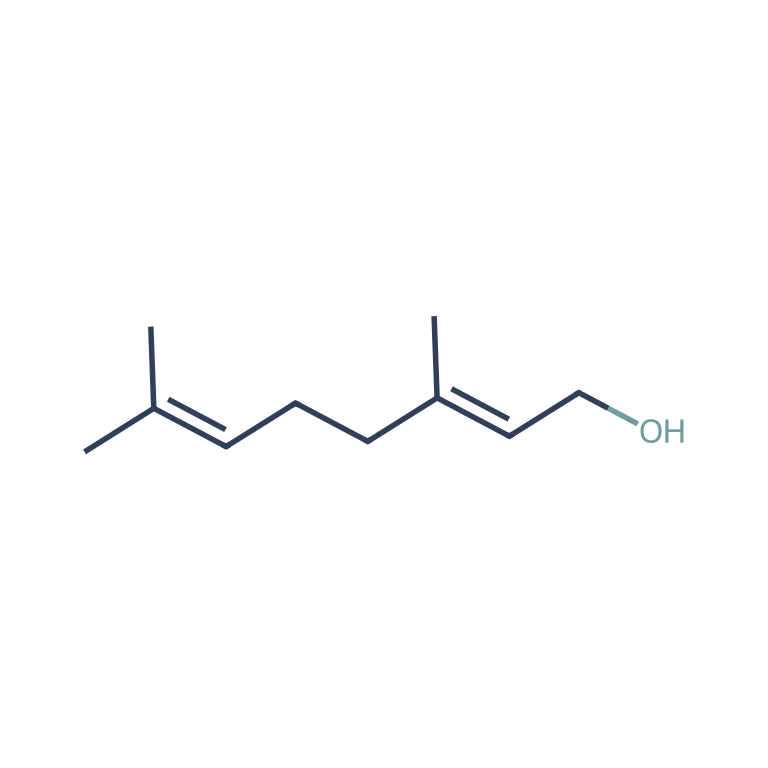
Geraniol is a naturally occurring terpene with the molecular formula C10H18O. It has an open carbon chain containing two carbon-carbon double bonds and an alcohol group, placing it within the monoterpene alcohol family.
Geraniol is closely related to nerol. Both compounds contain the same atoms, but differ in the arrangement around one of their double bonds. Geraniol can also gradually oxidize when exposed to air, forming other aroma compounds over time.
Reported effects
Geraniol has been studied in several animal and laboratory models. Research supports sedating effects, pain and inflammation reduction, improvements in impaired cognitive function, and relaxation of smooth muscle.
Sedating
Animal studiesGeraniol has reduced spontaneous movement and produced sedating effects in mice after both inhalation and systemic administration. It has also increased the effects of general anaesthetics, while brain recordings show increased inhibitory signalling in areas involved in alertness.
Pain & inflammation
Preclinical studiesGeraniol has reduced pain responses in several animal models, including inflammatory and nerve-related pain. It has also reduced inflammatory signalling and immune-cell activity in laboratory and animal studies.
Cognitive support
Animal studiesGeraniol has improved learning and memory in several animal models involving cognitive impairment. Studies have reported improvements in spatial memory, recognition memory and memory retention, together with better functioning of connections between neurons in the hippocampus.
Muscle relaxation
Laboratory studiesGeraniol can directly relax smooth muscle. In isolated blood vessels it reduced contraction even when the surrounding tissue responsible for producing normal relaxing signals was removed, indicating a direct effect on the muscle cells themselves.
Molecular targets
Geraniol directly influences several receptors and ion channels involved in nervous-system activity, pain, inflammation and muscle function. Evidence supports activity at GABA-A, 5-HT3 and adenosine A2A receptors, TRP channels, potassium channels and calcium channels.
GABA-A receptor
GABA-A is one of the main inhibitory receptors in the brain and helps reduce activity between nerve cells.
Geraniol can directly increase GABA-A receptor activity. Functional receptor experiments found positive modulation, while recordings from brain neurons showed prolonged inhibitory signalling and increased tonic inhibition.
This interaction may contribute to the sedating effects observed with Geraniol.
5-HT receptors
5-HT receptors respond to serotonin and are involved in processes such as mood, pain, nausea and nervous-system signalling.
Geraniol directly inhibits the 5-HT3 receptor. Laboratory experiments found an IC50 of approximately 188 µM for inhibition of 5-HT3A receptor currents.
This makes 5-HT3 a directly supported molecular target of Geraniol.
TRP channels
TRP channels are sensory ion channels involved in processes such as pain, temperature and irritation.
Geraniol directly activates TRPV1, which can initially increase warmth and irritation but may reduce pain sensitivity after stronger or repeated activation through channel desensitization.
Geraniol directly activates TRPM8, which can produce cooling sensations and influence pain perception, although stronger activation may also increase sensitivity to cold.
Geraniol also interacts with TRPA1, but studies report both weak activation and inhibition depending on concentration and experimental conditions, so its overall effect on irritation and pain signalling through this channel remains uncertain.
Adenosine A2A receptor
Adenosine A2A receptors are involved in pain, inflammation, movement and nervous-system signalling.
Geraniol activates A2A receptor signalling in cells expressing the receptor. Animal studies also show that blocking or reducing A2A receptors strongly reduces its pain-relieving effects.
Current evidence suggests that Geraniol behaves as a relatively weak partial A2A receptor agonist.
Potassium channels
Potassium channels help control the electrical activity of nerve, muscle and immune cells.
Geraniol directly inhibits the Kv1.3 potassium channel, with an IC50 of approximately 491 µM. It also inhibits several voltage-dependent potassium currents in heart cells.
These interactions may contribute to its effects on inflammatory signalling and cellular electrical activity.
Calcium channels
Calcium channels control calcium entry into cells and are important for nerve signalling and muscle contraction.
Geraniol directly inhibits L-type calcium currents. In heart cells, 300 µM Geraniol reduced the L-type calcium current by approximately 51%.
This inhibition also helps explain the smooth-muscle relaxing effects observed in laboratory studies.