
What is Valencene?
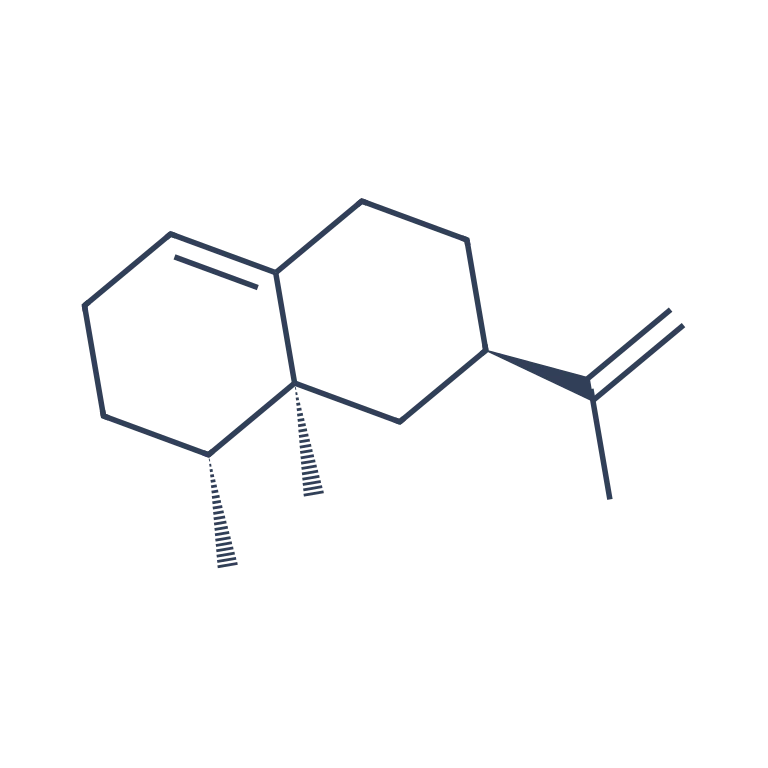
Valencene is a naturally occurring terpene with the molecular formula C15H24. It has a compact structure containing two connected carbon rings and belongs to the sesquiterpene family.
Naturally occurring Valencene is commonly found as (+)-Valencene. It can also be converted through oxidation into compounds such as Nootkatone, another naturally occurring aroma compound found prominently in grapefruit.
Reported effects
Valencene has been studied mainly in animal and laboratory models. Its best supported reported effect involves inflammation, while direct research on pain reduction remains more limited.
Pain & inflammation
Preclinical studiesValencene has reduced inflammatory swelling, immune-cell activity and inflammatory signalling in laboratory and animal studies. Effects have been observed in both acute and long-lasting inflammatory models, although direct evidence for pain relief is still limited.
Molecular targets
Valencene directly inhibits two ion channels involved in calcium and sensory signalling: TRPV1 and ORAI1. These interactions have been measured directly using electrophysiological techniques.
TRP channels
TRP channels are sensory ion channels involved in processes such as pain, temperature and irritation.
Valencene directly inhibits TRPV1. In patch-clamp experiments, 90 µM Valencene reduced capsaicin-induced TRPV1 currents by approximately 69%.
TRPV1 normally responds to heat, acidity and compounds such as capsaicin. Reducing its activity can therefore influence calcium entry and sensory signalling.
Because the inhibition was measured directly as electrical current through the channel, TRPV1 can be considered a well-supported molecular target of Valencene.
Calcium channels
Calcium channels regulate the movement of calcium into cells and are involved in processes ranging from nerve signalling to muscle activity and cellular responses.
Valencene strongly inhibits ORAI1, a calcium channel that allows calcium to enter cells after internal calcium stores have been depleted. At 90 µM, Valencene reduced ORAI1 currents by approximately 97% in electrophysiological experiments.
A separate calcium-imaging experiment confirmed this effect, showing that 50 µM Valencene reduced the increase in intracellular calcium caused by ORAI1 activation by approximately 85%.
This combination of direct channel recordings and calcium measurements makes ORAI1 one of the clearest molecular targets currently identified for Valencene.