
What is α-Bisabolol?
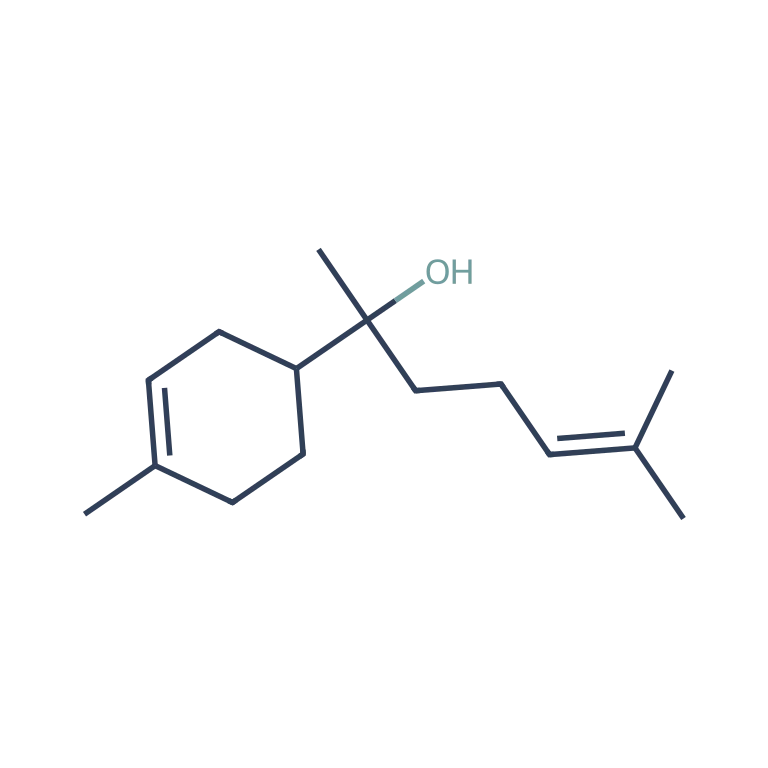
α-Bisabolol is a naturally occurring terpene with the molecular formula C15H26O. It has one carbon ring and also contains an alcohol group, placing it within the sesquiterpene alcohol family.
α-Bisabolol can occur in different mirror-image forms. The naturally occurring (-)-α-Bisabolol form has been used in much of the research on its biological activity.
Reported effects
α-Bisabolol has been studied mainly in animal and laboratory models. Its strongest reported effects involve pain and inflammation, while several animal studies also suggest possible support for memory and cognitive function under conditions involving neurological stress or inflammation.
Pain & inflammation
Preclinical studiesα-Bisabolol has reduced pain responses, swelling and inflammatory signalling in several animal models. Effects have been observed in inflammatory, visceral and nerve-related pain, making this one of its best studied reported effects.
Cognitive support
Animal studiesα-Bisabolol has improved memory performance in animal models involving brain injury, inflammation and cognitive impairment. These benefits were accompanied by reduced inflammation and neuronal damage, although cognitive effects in healthy humans have not been established.
Molecular targets
The clearest direct molecular target identified for α-Bisabolol is the Cav3.2 T-type calcium channel, which is involved in the transmission of pain signals through sensory nerves.
Calcium channels
Calcium channels control the movement of calcium into cells and play important roles in nerve signalling, muscle activity and the transmission of pain.
α-Bisabolol directly inhibits Cav3.2 T-type calcium channels. Laboratory experiments found that it reduced calcium-channel currents at low micromolar concentrations.
This interaction also appears to matter in living animals. α-Bisabolol reduced inflammatory and nerve-related pain in normal mice, but the effect disappeared in mice that lacked Cav3.2 channels.
This provides unusually strong evidence that Cav3.2 inhibition is not only a laboratory interaction, but directly contributes to the pain-related effects of α-Bisabolol.