
What is Nerolidol?
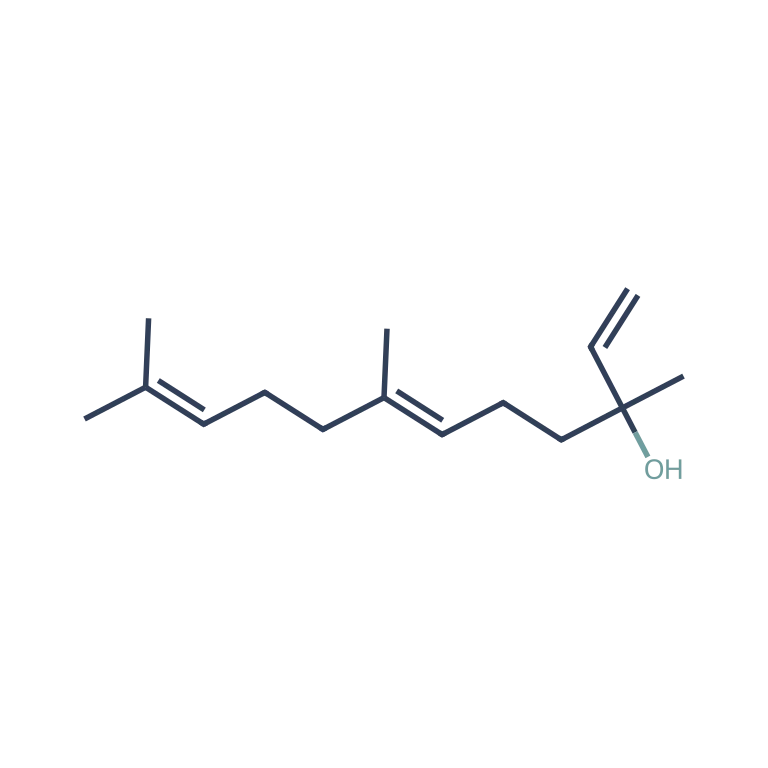
Nerolidol is a naturally occurring terpene with the molecular formula C15H26O. It has a long open carbon chain containing three carbon-carbon double bonds and an alcohol group, placing it within the sesquiterpene alcohol family.
Nerolidol occurs naturally in two main geometric forms, cis-Nerolidol and trans-Nerolidol. The difference is caused by the arrangement around one of their double bonds, while both forms share the same molecular formula.
Reported effects
Nerolidol has been studied mainly in animal and laboratory models. Research supports calming effects, pain and inflammation reduction, and improvements in impaired learning and memory under several experimental conditions.
Calming
Animal studiesNerolidol reduced anxiety-like behaviour in mice across several doses. The animals spent more time exploring normally avoided areas without impaired motor coordination, supporting a calming rather than simply movement-suppressing effect.
Pain & inflammation
Preclinical studiesNerolidol has reduced pain behaviour in several mouse models and has also reduced inflammatory swelling, immune-cell movement and inflammatory signals such as TNF-α and IL-1β. Similar anti-inflammatory effects have been reported in models of arthritis and intestinal inflammation.
Cognitive support
Animal studiesNerolidol has improved learning and memory in animal models involving Alzheimer's-like changes, brain injury, neuroinflammation and other forms of cognitive impairment. These effects have been accompanied by reduced neuronal damage and improvements in signalling involved in memory formation.
Molecular targets
Nerolidol has been linked most clearly to GABA-A signalling and the TRPV1 ion channel. Both interactions have experimental support, although the results vary between different laboratory models.
GABA-A receptor
GABA-A is one of the main inhibitory receptors in the nervous system and plays an important role in calming excessive activity between nerve cells.
In animal pain experiments, blocking GABA-A receptors with bicuculline reduced the pain-relieving effect of Nerolidol. This shows that GABA-A signalling contributes to at least part of its biological activity.
Laboratory studies of the receptor itself have produced mixed results. One earlier experiment found that Nerolidol increased the response to GABA, while another study found little meaningful modulation at a somewhat lower concentration.
GABA-A is therefore a supported signalling target, but the exact strength and type of direct receptor interaction remain uncertain.
TRP channels
TRP channels are sensory ion channels involved in processes such as pain, temperature and irritation.
Nerolidol has directly activated TRPV1 in cells engineered to express this channel, producing an increase in calcium entry. This supports TRPV1 as a possible direct molecular target.
However, later experiments using sensory nerve cells found responses to Nerolidol in only a small proportion of cells and suggested that these responses may not always be caused by TRPV1.
The interaction with TRPV1 is therefore supported by direct laboratory evidence, but it appears to depend strongly on the experimental system and concentration used.