
What is Linalool?
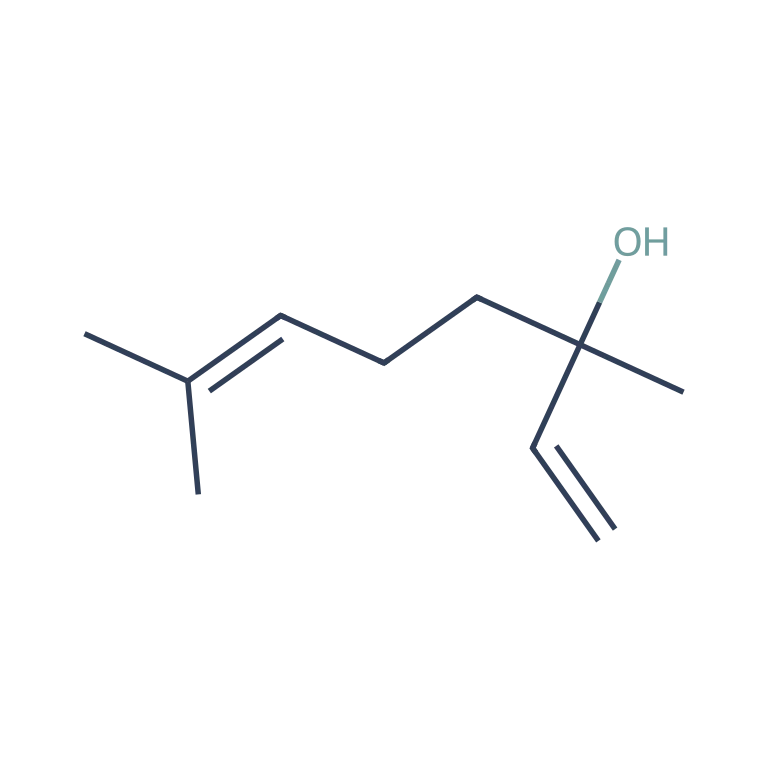
Linalool is a naturally occurring terpene with the molecular formula C10H18O. Unlike ring-shaped terpenes such as α-Pinene, its carbon structure forms an open chain. It also contains an alcohol group, which gives it somewhat different chemical properties from terpenes made only from carbon and hydrogen.
Linalool exists in two mirror-image forms called (R)-Linalool and (S)-Linalool. Both occur naturally, and different plants can contain very different proportions of the two forms.
Reported effects
Linalool has been studied extensively in animal and laboratory models. Its calming and sedating effects are among the better studied behavioural effects of common terpenes, while evidence for cognitive and muscle-related effects depends more strongly on the experimental conditions.
Calming
Animal studiesInhaled Linalool has reduced anxiety-like behaviour in several mouse studies. The effect has also been observed without a clear reduction in normal movement at appropriate exposure levels.
Sedating
Animal studiesLinalool has produced dose-dependent sedating effects in animal research. Its influence on inhibitory signalling in the brain is thought to contribute to this effect.
Cognitive support
Animal studiesLinalool has improved learning and memory in animal models involving sleep deprivation, ageing and neurological damage. However, high doses have also impaired memory formation in healthy animals, showing that the effect depends strongly on dose and condition.
Muscle relaxation
Laboratory studiesLinalool has relaxed smooth muscle in laboratory experiments, including isolated human and rat intestinal tissue. Most direct evidence involves smooth muscle rather than the skeletal muscles used for movement.
Molecular targets
Linalool directly influences several receptors and ion channels involved in inhibitory signalling, sensory processing and nerve excitability. Evidence supports activity at GABA-A, NMDA and 5-HT3 receptors, TRP channels, voltage-dependent calcium channels and sodium channels.
GABA-A receptor
GABA-A is one of the main inhibitory receptors in the brain and helps reduce excessive activity between nerve cells.
Linalool directly modulates GABA-A receptors. In one receptor system it increased GABA-induced currents, acting as a positive allosteric modulator.
The exact effect appears to depend on receptor composition and experimental conditions, as inhibition has also been reported at high concentrations in another GABA-A receptor subtype.
NMDA receptor
NMDA receptors respond to glutamate and play important roles in learning, memory and communication between nerve cells.
Linalool directly interferes with the NMDA receptor complex. Binding experiments found concentration-dependent inhibition, although relatively high concentrations were required.
Reduced NMDA signalling may contribute to some of the nervous-system effects of Linalool and may also help explain why high experimental doses can interfere with memory formation.
5-HT receptors
5-HT receptors respond to serotonin and are involved in processes such as mood, stress, sleep and sensory signalling.
Linalool directly inhibits the human 5-HT3 receptor. Laboratory experiments found an IC50 of approximately 141 µM.
The inhibition is noncompetitive, indicating that Linalool modulates the receptor without competing directly with serotonin at its normal binding site.
TRP channels
TRP channels are sensory ion channels involved in processes such as pain, temperature and irritation.
Linalool directly interacts with TRPA1. It can weakly activate the channel under some conditions while also strongly reducing TRPA1 activation produced by other compounds.
These findings indicate that the effect depends on concentration and the way the channel is activated.
Calcium channels
Voltage-dependent calcium channels control calcium entry into cells and are important for nerve signalling, sensory processing and muscle contraction.
Linalool directly reduces voltage-dependent calcium currents in sensory neurons. This decreases calcium entry when the nerve cells are electrically activated.
Calcium-channel inhibition may contribute to its effects on sensory signalling and smooth-muscle relaxation.
Sodium channels
Voltage-dependent sodium channels allow electrical signals to travel through nerves.
Linalool directly inhibits voltage-dependent sodium currents in sensory neurons. It also reduces the ability of peripheral nerves to generate and transmit electrical signals.
This interaction may contribute to the reduced nerve excitability and local pain-related effects observed in laboratory experiments.