
What is β-Pinene?
β-Pinene is a naturally occurring terpene with the molecular formula C10H16. It has a compact structure made up of two connected carbon rings and is closely related to α-Pinene.
α-Pinene and β-Pinene contain the same atoms but differ in the position of one carbon-carbon double bond. This small structural difference gives the two compounds different physical and biological properties.
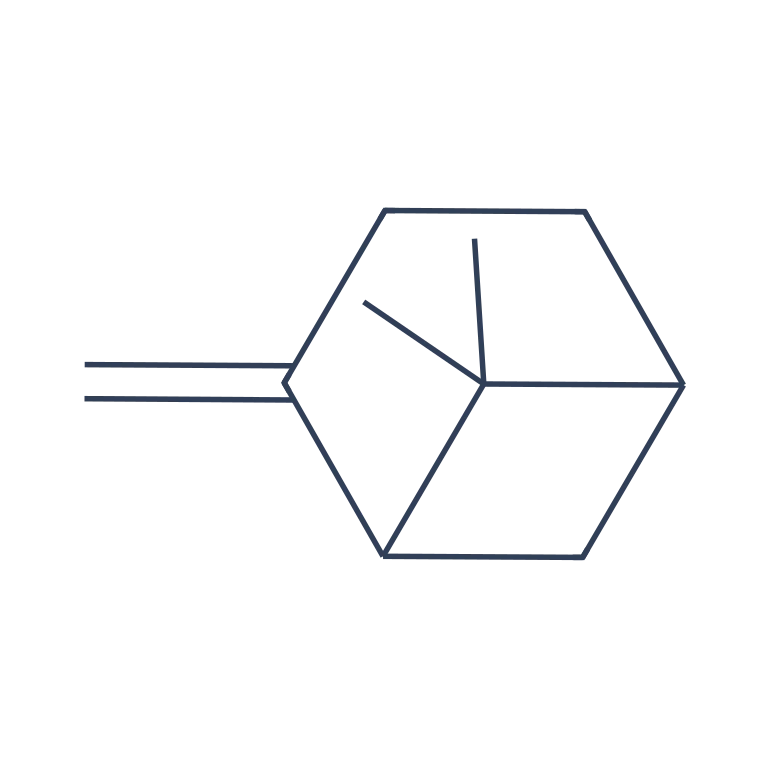
Reported effects
Research on β-Pinene is still mainly limited to animal studies. Its behavioural effects appear to involve several signalling systems in the brain, while its effects on activity can vary depending on the experimental conditions.
Calming
Animal studiesβ-Pinene has produced anxiety-reducing and sedative-like behaviour in mouse studies. These findings suggest a possible calming effect, although controlled human research with isolated β-Pinene is not yet available.
Uplifting & energizing
Animal studiesβ-Pinene has produced antidepressant-like behaviour in mice, including increased active behaviour during behavioural tests. However, it does not consistently increase general activity and has reduced spontaneous movement in some experiments. The evidence therefore supports the uplifting side of this effect more strongly than the energizing side.
Pain & inflammation
Preclinical studiesβ-Pinene has reduced pain responses in animal experiments and has also reduced swelling and immune-cell movement in models of inflammation. These effects have not appeared equally strongly in every pain model, so the evidence remains preclinical.
Molecular targets
No direct molecular target has yet been clearly established for β-Pinene. Research shows involvement of serotonin, adrenergic and dopamine signalling, but direct binding or activation of these receptors has not been demonstrated.
In animal studies, blocking 5-HT1A, β-adrenergic or dopamine D1 receptors prevented the antidepressant-like effect of β-Pinene. These findings show that the monoamine systems contribute to its behavioural effects, but they do not establish these receptors as direct molecular targets.