
What is Camphene?
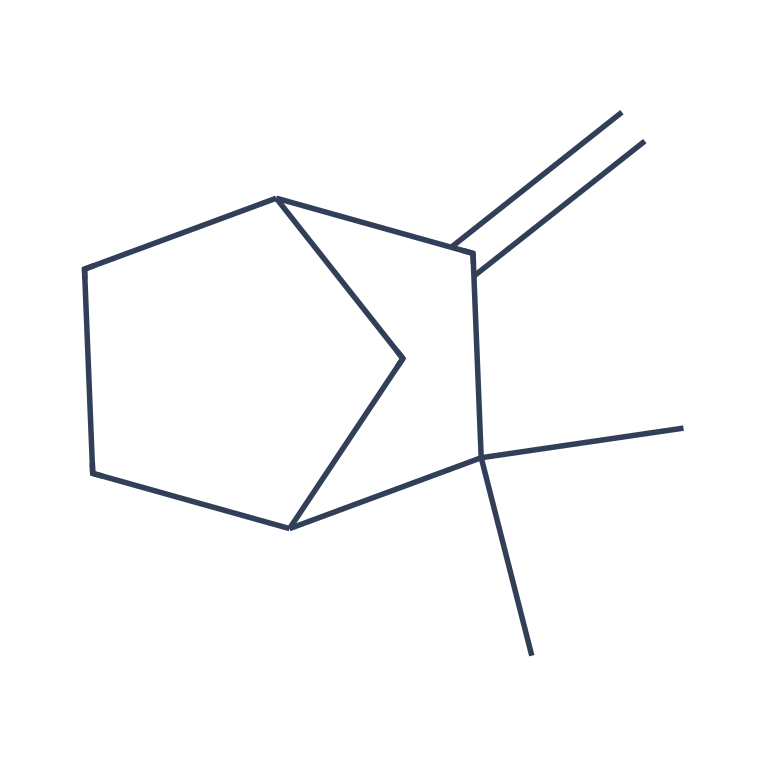
Camphene is a naturally occurring terpene with the molecular formula C10H16. It has a compact structure made up of two connected carbon rings and is closely related to several other bicyclic monoterpenes.
Unlike most common cannabis terpenes, Camphene can occur as a crystalline solid at room temperature. Pure Camphene typically melts at around 46 to 52°C.
Reported effects
Direct research on Camphene is still limited, but its effects on pain have been demonstrated in several animal models. These effects appear to be closely linked to its action on T-type calcium channels.
Pain & inflammation
Animal studiesCamphene has reduced pain responses in animal models of acute inflammatory pain, long-lasting inflammatory pain and nerve-related pain. It also reduced increased sensitivity to heat and mechanical pressure in these experiments.
Molecular targets
The clearest direct molecular target identified for Camphene is the Cav3.2 T-type calcium channel, which plays an important role in transmitting pain signals through sensory nerves.
Calcium channels
Calcium channels control the movement of calcium into cells and are important for nerve signalling, muscle activity and pain processing.
Camphene directly inhibits Cav3.2 T-type calcium channels. Laboratory experiments found partial inhibition at low micromolar concentrations, and Camphene also reduced native T-type calcium currents in sensory nerve cells.
Smaller effects were also observed at the related Cav3.1 and Cav3.3 channels, but Cav3.2 appears to be the most important target for its pain-related activity.
In animal experiments, Camphene reduced inflammatory and nerve-related pain in normal mice, while important parts of this effect disappeared in mice lacking Cav3.2 channels. This provides strong evidence that Cav3.2 inhibition directly contributes to its pain-reducing effects.