
What is Eucalyptol?
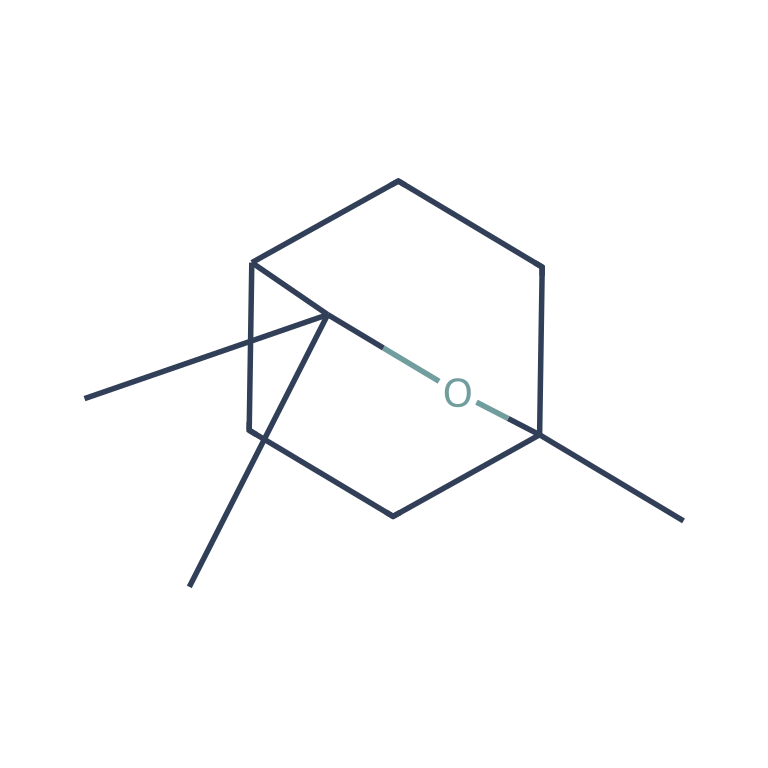
Eucalyptol is a naturally occurring terpene with the molecular formula C10H18O. It is also widely known as 1,8-Cineole and contains an oxygen atom incorporated directly into its compact bicyclic structure.
Unlike terpene alcohols such as Linalool or Geraniol, Eucalyptol contains its oxygen as an ether rather than an alcohol group. Its rigid ring structure also makes it chemically distinct from many other common monoterpenes.
Reported effects
Eucalyptol has been studied in animal, laboratory and limited human research. Its best supported effects involve calming behaviour, pain and inflammation, cognitive processes and relaxation of smooth muscle.
Calming
Animal studiesEucalyptol has reduced anxiety-like behaviour in mice and rats. In several experiments, animals showed greater exploration of normally avoided areas without a corresponding loss of normal motor function, supporting a calming rather than simply movement-suppressing effect.
Pain & inflammation
Preclinical studiesEucalyptol has reduced inflammatory swelling, pain sensitivity and inflammatory signalling in animal models. These effects included lower levels of cytokines such as TNF-α, IL-1β and IL-6 and were strongly linked to activity at sensory TRP channels.
Cognitive support
Preclinical & human researchEucalyptol has shown protective effects in experimental models involving Alzheimer's-like changes, including reductions in amyloid-beta production and abnormal tau activity. Human aroma studies have also linked higher absorbed 1,8-Cineole levels with better speed and accuracy on cognitive tasks, although controlled research with isolated Eucalyptol remains limited and has produced mixed results.
Muscle relaxation
Laboratory studiesEucalyptol can directly relax smooth muscle. It has reduced contractions in airway and intestinal tissue, with experiments showing that inhibition of calcium entry into muscle cells contributes to this effect.
Molecular targets
Eucalyptol directly influences several receptors and ion channels involved in sensory signalling, nerve excitability and muscle activity. Evidence supports activity at TRP channels, 5-HT3 receptors, calcium channels, sodium channels and potassium channels.
TRP channels
TRP channels are sensory ion channels involved in processes such as temperature, pain and irritation.
Eucalyptol directly activates TRPM8, a channel involved in sensing cool temperatures. Patch-clamp experiments confirmed electrical currents through human TRPM8 after exposure to Eucalyptol.
Eucalyptol also directly inhibits human TRPA1 currents produced by several different activating compounds.
5-HT receptors
5-HT receptors respond to serotonin and are involved in processes such as mood, nausea, pain and nervous-system signalling.
Eucalyptol directly inhibits the human 5-HT3 receptor, with an IC50 of approximately 258 µM.
The inhibition is noncompetitive, meaning Eucalyptol modulates the receptor without competing directly with serotonin at its normal binding site.
Calcium channels
Calcium channels control calcium entry into cells and play important roles in nerve signalling and muscle contraction.
Eucalyptol directly inhibits voltage-dependent L-type calcium channels. This has been demonstrated using patch-clamp recordings from isolated smooth-muscle cells.
Reduced calcium entry contributes to the smooth-muscle relaxing effects observed with Eucalyptol.
Sodium channels
Voltage-dependent sodium channels are essential for generating and transmitting electrical signals through nerves.
Eucalyptol directly reduces sodium currents in peripheral neurons and also changes several properties controlling channel activation and inactivation.
This inhibition reduces neuronal excitability and may contribute to some of its sensory and pain-related effects.
Potassium channels
Potassium channels help control the electrical activity and excitability of nerve cells.
Eucalyptol directly reduces voltage-dependent potassium currents in sensory neurons. Electrophysiological experiments found concentration-dependent inhibition of both peak and sustained potassium currents.
The exact potassium-channel subtypes responsible for these effects have not yet been fully established, although Kv2.1 and Kv3.4 have been proposed as possible targets.